Google reviews carry a remarkable amount of weight for local businesses.
Before someone calls a roofing contractor, HVAC company, plumber, transmission shop, collision center, or another service provider, there’s a good chance they’ve already looked at the company’s reviews. Maybe they read three of them. Maybe twenty. Either way, they’re forming an opinion long before anyone answers the phone.
A strong rating helps. So does having plenty of reviews. But there’s another piece that matters just as much: recent, authentic feedback from actual customers.
That’s where some businesses get themselves into trouble.
A competitor has 400 reviews. You have 73. They’re sitting at 4.9 stars, and you’re wondering how you’ll ever catch them.
Then somebody offers a shortcut.
“We can add 50 five-star Google reviews to your profile.”
Tempting?
Sure.
Smart?
Not really.
Buying Google reviews can violate Google’s policies, expose your Google Business Profile to unnecessary risk, and erode the very thing those reviews are supposed to create—trust.
There is a better way to build your reputation. It isn’t flashy, and it doesn’t happen overnight.
But it works.
Yes, You Can Buy Google Reviews. That Doesn’t Mean You Should.
Finding someone willing to sell Google reviews isn’t difficult.
Search around long enough and you’ll encounter companies promising everything from a handful of five-star reviews to large review packages delivered gradually over several weeks.
The offers can sound surprisingly sophisticated.
You may see claims about reviews coming from “real Google accounts,” geographically relevant users, staggered posting schedules, or even replacement guarantees if a review disappears.
All of this is designed to make purchased reviews feel legitimate.
They’re still purchased reviews.
And here’s the larger problem: you don’t control what Google detects today, tomorrow, or six months from now.
A review that survives initially isn’t necessarily safe forever. Suspicious reviews can be removed later, and multiple reviews may disappear during enforcement actions.
Google wants reviews to reflect genuine experiences with a business.
If someone has never hired your company, visited your location, purchased your product, or received your service, paying that person to pretend otherwise isn’t reputation marketing.
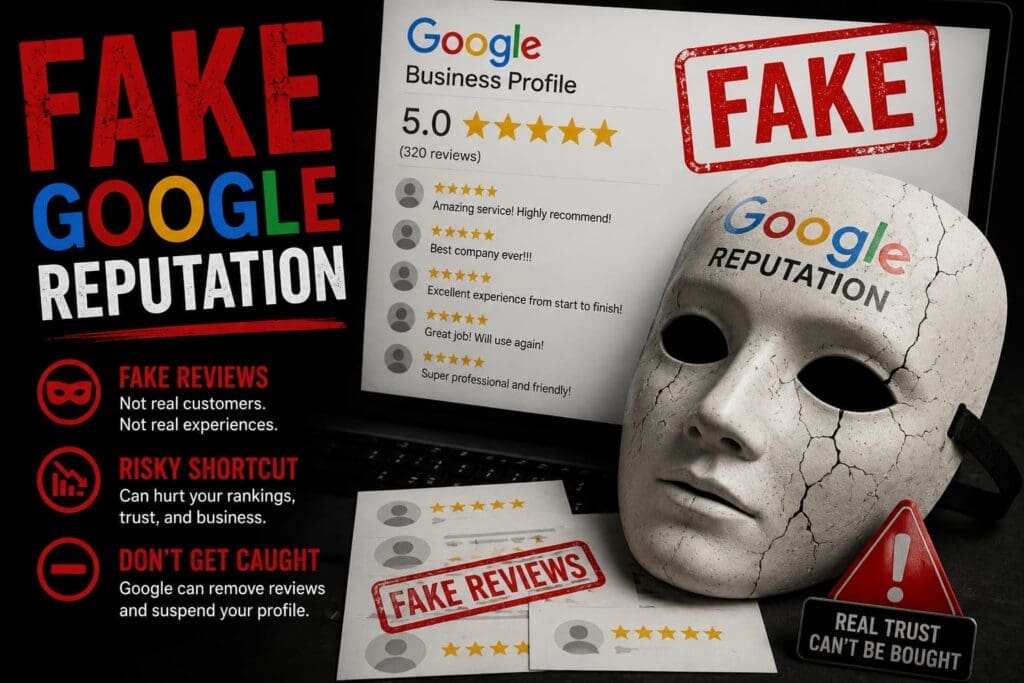
It’s manufacturing a reputation.
Those are two very different things.
Most business owners aren’t looking at fake reviews because they woke up one morning wanting to manipulate Google.
Usually, they’re looking at competitors.
Suppose your company has 47 reviews with a 4.8-star rating.
The company down the street has 312 reviews and a 4.9-star rating.
Both appear in Google Maps.
A customer who knows nothing about either business sees those two profiles side by side.
Who looks more established?
That’s the pressure.
Reviews create social proof, and a substantial review count can make a company appear busier, more experienced, and more trusted by its community.
But simply accumulating the largest number isn’t the objective.
A healthy review profile should feel alive.
New customers are leaving feedback. Older reviews provide history. People describe actual services and experiences. The business responds. Reviews arrive naturally over time.
You don’t merely want more reviews.
You want a review profile customers believe.
Buying Reviews Can Cost More Than the Purchase Price
The obvious risk is wasting money.
You purchase 50 reviews.
They appear.
A few weeks or months later, some disappear.
Now you’ve paid for something you no longer have.
That’s irritating, but it may not be the biggest concern.
Fake Reviews Can Be Removed
Google removes reviews it determines violate its policies.
That means a purchased review isn’t an asset you can count on keeping. It could remain visible for some time or vanish later.
Think about what you’re actually purchasing.
Not customer loyalty.
Not a referral.
Not repeat business.
Not even a guaranteed review.
You’re paying for the temporary appearance of customer satisfaction.
That’s a shaky investment.

Your Google Business Profile Is Too Valuable to Gamble With
For many local companies, their Google Business Profile is one of their most productive digital assets.
It can generate:
- Phone calls
- Website visits
- Driving directions
- Quote requests
- Service appointments
- New customers
That’s real business.
Trying to manipulate reviews puts an asset capable of producing revenue at needless risk.
When your Google Business Profile is already helping customers discover and contact you, protecting its integrity should be a priority.
Customers Can Smell Something Fishy
People aren’t oblivious.
They’ve been reading online reviews for years, and suspicious patterns stand out.
Twenty reviews that essentially say:
“Great service! Great company! Highly recommend!”
aren’t particularly persuasive.
Compare that with a customer who explains that their air conditioner stopped cooling on a 110-degree afternoon, mentions the technician who arrived, describes what was repaired, and talks about how the company handled the service call.
Which review would you trust?
Exactly.
Specificity gives reviews credibility.
Real experiences contain details that manufactured enthusiasm usually doesn’t.
Review Gating: The Shortcut That Doesn’t Look Like a Shortcut
Buying reviews isn’t the only questionable practice businesses should watch for.
There’s also review gating.
Review gating occurs when a business attempts to identify happy customers first and then selectively encourages those people to leave public reviews.
Here’s a common version.
A customer receives a survey:
How would you rate your experience?
Someone selecting four or five stars gets directed to Google.
Great! Please leave us a review.
Someone selecting one, two, or three stars gets routed to a private feedback form instead.
That customer never receives the same invitation to review the business publicly.
See what’s happening?
The business isn’t merely requesting feedback. It’s attempting to influence which experiences become visible.
A sound review process shouldn’t be built around identifying likely five-star customers while quietly diverting everyone else.
Ask customers for honest feedback without predetermining what you want them to say.
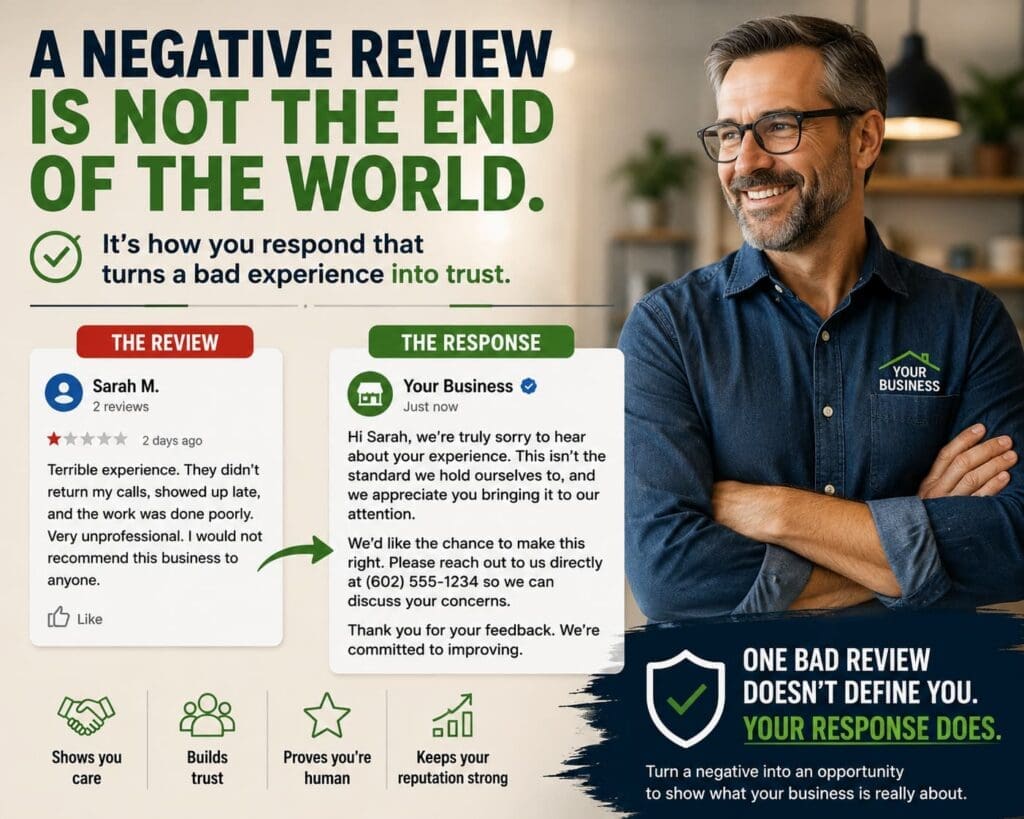
A Negative Review Isn’t the End of the World
Business owners naturally dislike negative reviews.
We get it.
Nobody celebrates seeing a one-star notification pop up.
But an occasional negative review among hundreds of positive ones doesn’t automatically destroy a company’s reputation.
In some cases, an imperfect rating can even make the overall profile feel more credible.
Think about it.
Would you immediately dismiss an established local company with 250 reviews and a 4.8 rating?
Probably not.
You’d likely read some of the reviews.
And you’d probably look at how the company responded to complaints.
That’s an opportunity.
A thoughtful response tells prospective customers:
We listen. We respond. We care about resolving problems.
Don’t become combative. Don’t write a 900-word rebuttal proving the customer wrong. Don’t turn the review section into a courtroom.
Stay professional.
Acknowledge the concern. Provide context when necessary. Invite the customer to continue the conversation privately when appropriate.
Remember, you’re not only responding to the person who wrote the review.
You’re responding for everyone who reads it afterward.
Review Velocity: Don’t Just Count Reviews—Look at the Pattern
This brings us to something many businesses overlook:
Review velocity.
In plain English, review velocity describes how your reviews accumulate over time.
Consider two companies.
Business A: 275 reviews, but only three were posted during the past year.
Business B: 190 reviews, with fresh reviews appearing consistently throughout the year.
Business A has the bigger number.
Business B has the fresher reputation.
That’s an important distinction.
Your goal shouldn’t be to run a frantic review campaign twice a year, pile up a bunch of reviews, and then forget about them.
Reviews should accompany the normal rhythm of doing business.
You serve customers every week.
Your review activity should reflect that.
Beware of Strange Review Spikes
Imagine a company that normally receives three to five reviews per month.
Then something unusual happens.
Thirty-seven five-star reviews appear in seven days.
The following month?
Four reviews.
Then three.
Then five.
That enormous spike looks peculiar because it doesn’t resemble the company’s established customer-review pattern.
Instead of obsessing over getting exactly 10 or 20 reviews every month, concentrate on consistency.
You might receive eight this month, eleven next month, seven after that, and thirteen the month after.
That’s business.
Customer volume changes. Seasons change. Some people leave reviews and others don’t.
Natural fluctuation is expected.
What you want is a steady cadence of genuine customer feedback, not an artificial avalanche followed by silence.
So, What Actually Works?
This part isn’t particularly mysterious.
Do great work and make leaving a review ridiculously easy.
Many businesses already handle the first half.
They provide excellent service. Customers are happy. Someone at the front desk says:
“We’d really appreciate it if you left us a Google review.”
The customer means to do it.
Then life intervenes.
They drive home. Dinner happens. The dog needs to go outside. An email comes in. The kids need something. Tomorrow gets busy.
Three days later, that review is long forgotten.
The customer wasn’t unhappy.
They simply moved on.
That’s why businesses need a review-request process, not an occasional verbal reminder.
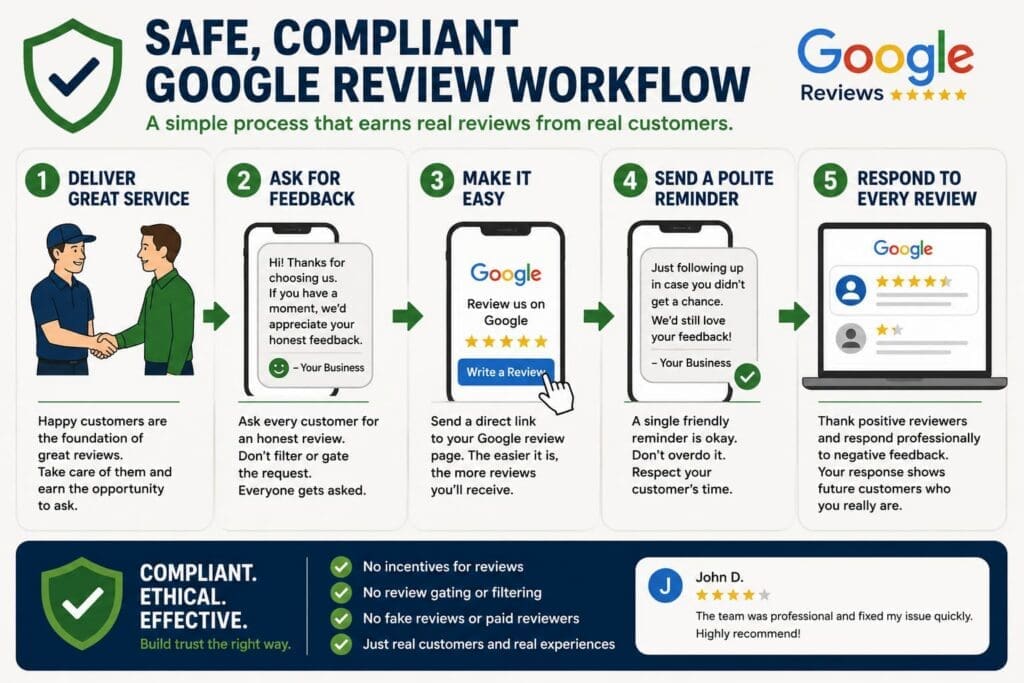
A Simple, Compliant Google Review-Request Workflow
You don’t need an elaborate system with twelve automations and six different customer surveys.
Keep it straightforward.
Step 1: Earn the Review Before You Ask for It
Reputation starts with the actual customer experience.
Show up.
Communicate.
Do what you promised.
Solve the customer’s problem.
Treat people well.
No software, QR code, text-message campaign, or clever review strategy can rescue consistently lousy service.
Earn the opportunity first.
Step 2: Ask Customers for Honest Feedback
Make review requests part of your normal customer process rather than something employees remember to do occasionally.
Depending on the service, you might ask immediately after the job, later that afternoon, within the next 24–48 hours, or once the customer has had enough time to experience the finished work.
There isn’t one perfect moment for every industry.
A plumber completing an emergency repair is different from a roofing contractor finishing a major installation.
The principle is the same.
Ask while the experience is still fresh.
And don’t restrict the request to people you’ve already decided are happy.
Step 3: Remove the Friction
Never make customers hunt for your review page.
“Search our company on Google, find our profile, scroll down, click Reviews…”
You’ve already lost people.
Send them directly where they need to go.
One click.
Review page.
Done.
The easier the process is, the more likely customers are to finish what they intended to do.
Step 4: Follow Up Without Becoming Annoying
Customers forget.
A courteous reminder can recover reviews that otherwise would never happen.
One follow-up is often plenty.
You’re not trying to badger someone into praising your business. You’re simply reminding a customer who may have been busy when the original request arrived.
Keep it polite. Keep it brief.
Then move on.
Step 5: Respond to the Reviews You Receive
A review shouldn’t disappear into a digital black hole once it’s posted.
Respond.
Thank customers for positive feedback.
Address legitimate concerns professionally.
Your response adds another layer of information for prospective customers researching the company.
They’re watching how you interact with people.
Give them something reassuring to see.
Don’t Buy Five Stars With Discounts, Either
Here’s another idea that sounds harmless until you look closer:
“Leave us a five-star Google review and we’ll give you $20 off your next service.”
Don’t do that.
You’re not asking for candid feedback anymore. You’re attaching a financial benefit to a specific outcome.
There’s an enormous difference between wanting customer feedback and trying to purchase customer praise.
Your review strategy should never require customers to say something positive in exchange for a reward.
Let the experience determine the review.
If your company consistently takes care of people, the positive feedback will take care of itself.
How Many Google Reviews Do You Actually Need?
Business owners ask this constantly.
There’s no magic number.
Fifty reviews could be impressive in one market and woefully inadequate in another.
A plumber serving a smaller Arizona community shouldn’t automatically compare their review count with a large HVAC operation serving the entire Phoenix metro area.
The useful comparison is your actual competitive environment.
Search Google for the services you want customers to find you for.
Then examine the businesses appearing prominently.
Don’t just glance at the star rating.
Look deeper.
Consider their total reviews, recent review frequency, average rating, quality of customer comments, how recently reviews were posted, and whether the company responds.
Now you have a meaningful benchmark.
Suppose your strongest competitors hover around 250–300 reviews and your company has 28.
Yes, there’s a gap.
No, you shouldn’t try to erase it next Tuesday.
Build the process.
Keep serving customers.
Keep asking.
Let the gap narrow legitimately.
Reviews Aren’t Just an SEO Metric
This is the part that sometimes gets lost.
Google reviews aren’t valuable simply because they may contribute to local visibility.
Reviews help people make decisions.
Someone discovers your company through Google Search, Google Maps, an AI search result, your website, or a referral.
They don’t call immediately.
They investigate.
Who are these people?
Can I trust them?
Have they done this type of work before?
How do they treat customers?
What happens if something goes wrong?
Your advertising can tell someone you’re great.
Your website can say you’re experienced.
Your salespeople can promise exceptional service.
A customer describing their own experience carries a different kind of weight.
That’s why authentic reviews are so valuable.
They’re not merely stars beside your business name.
They’re evidence.
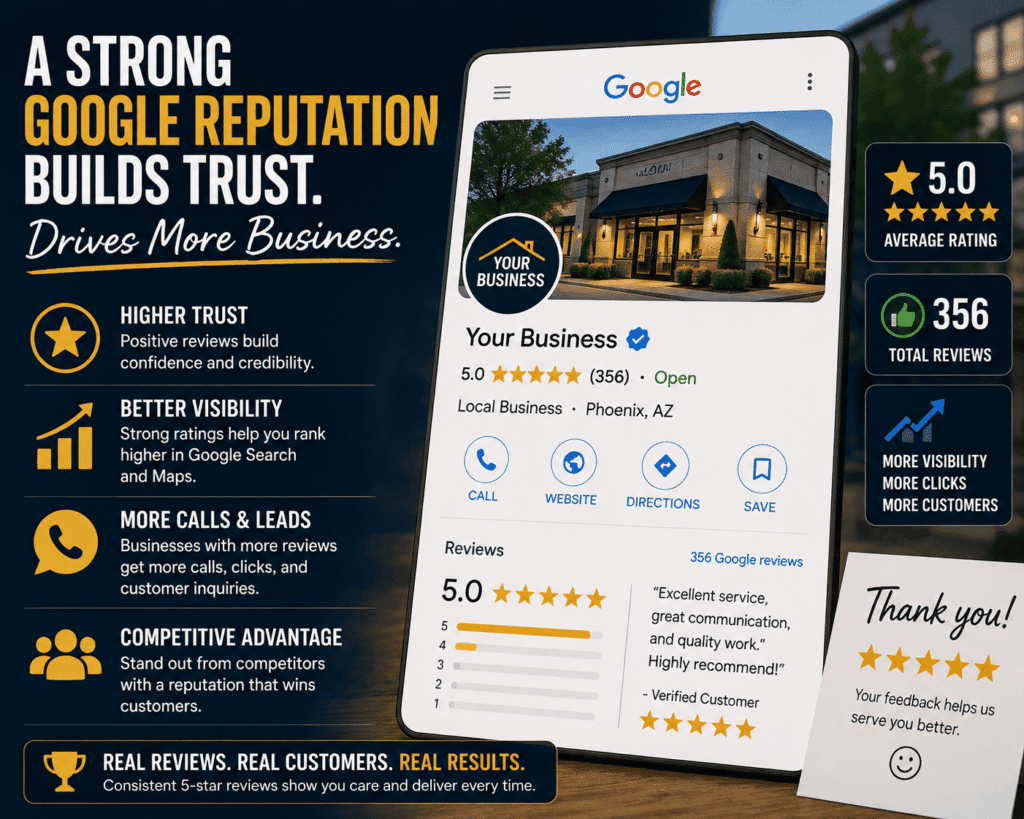
Build the Reputation Instead of Buying the Appearance of One
Buying Google reviews is appealing because it promises speed.
Review gating is appealing because it promises control.
Neither solves the real problem.
The businesses that develop formidable online reputations tend to do something much less exciting—and much more sustainable.
They take care of customers.
They ask for feedback.
They make the review process easy.
They generate reviews consistently.
They respond when customers speak.
Then they do it again.
And again.
Month after month.
That’s how 28 reviews become 75.
Then 150.
Then 300.
More importantly, those reviews represent something real: hundreds of customers who actually did business with the company.
You aren’t borrowing credibility.
You earned it.
Turn Your Local Visibility Into More Business
At FMS Online Marketing, we help established service businesses strengthen their visibility through Local SEO, Google Business Profile optimization, content strategy, AEO, GEO, and AI search visibility.
Reviews are part of that equation, but they’re not the whole equation.
Getting seen is only the beginning.
The real objective is turning that visibility into phone calls, qualified leads, and new customers.
If your business isn’t generating the local visibility—or the opportunities—you believe it should, contact FMS Online Marketing. Let’s find out what’s standing in the way.