
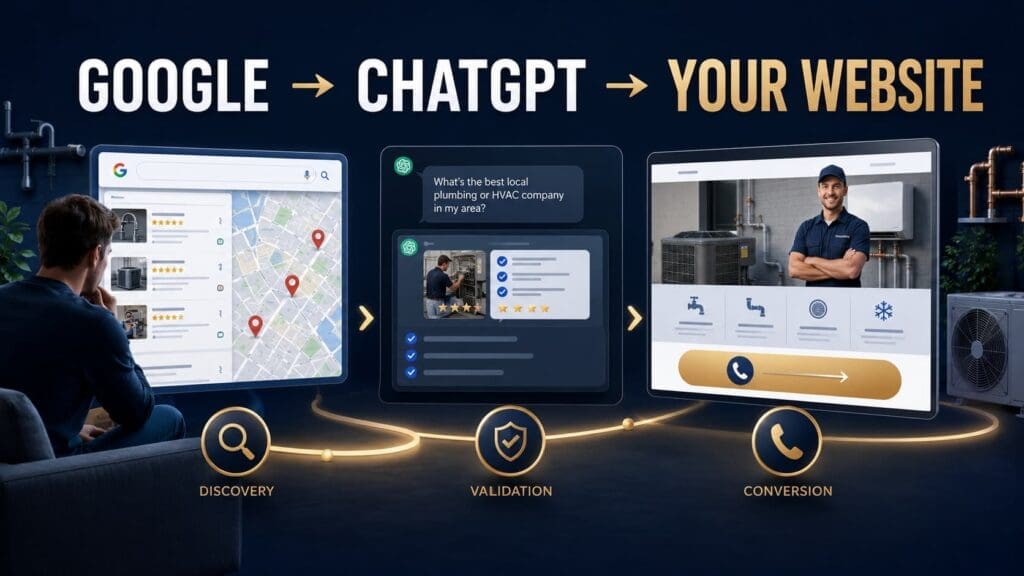
Google, Then ChatGPT, Then Your Website
Where plumbing and HVAC companies gain—or lose—customers during modern local research
A homeowner hears water running behind a wall at 9:30 at night. Another notices the air conditioner struggling during an Arizona afternoon. What happens next? Years ago, the answer was fairly predictable: open Google, choose a company near the top, visit its website, and call. That still happens, especially during emergencies, but it is no longer the only path. Today’s customer may discover three companies on Google, ask ChatGPT to help compare them, and visit only one website before making the call.
That shift changes the job of local marketing. A plumbing or HVAC company can rank well and still lose the customer during the next stage of research. It can also be mentioned by an AI answer and lose the lead because its website feels vague, slow, or untrustworthy. The modern journey is not one search and one click. It is a sequence of confidence checks, and your business has to survive each one.

The Customer Journey Is No Longer a Straight Line
The phrase “Google, then ChatGPT, then your website” describes a common modern pattern, not a rule that every customer follows in the same order. Urgent buyers may call directly from Google Maps. Careful homeowners may spend an evening reading reviews, asking AI follow-up questions, comparing financing options, and checking licenses before they contact anyone. Others may begin in ChatGPT, move to Google to verify local details, and finish on the company website.
What matters is that discovery, research, and conversion are increasingly happening across different platforms. Google can introduce the company. ChatGPT can help the customer organize choices and understand what to look for. The website must then prove that the business is credible, local, capable, and easy to contact. If those three layers tell different stories—or one of them is weak—the journey breaks.
Stage One: Google Creates the Shortlist
For most local plumbing and HVAC searches, Google remains the front door. A homeowner may search “emergency plumber near me,” “AC repair in Phoenix,” or “why is my air conditioner blowing warm air?” Google can show a Map Pack, local business profiles, organic results, review ratings, service information, ads, featured answers, and AI-generated summaries. The customer is not simply looking for a blue link. They are building a shortlist and judging whether each company appears relevant and dependable.
Google says local results are mainly based on relevance, distance, and prominence. That makes a complete Google Business Profile, correct service categories, accurate hours, strong reviews, consistent contact information, and locally relevant website content essential. Your profile and search appearance should answer the customer’s first questions quickly: Do you provide the service? Do you serve this area? Are you open? Do other customers trust you? Can I call now?
Where Plumbing and HVAC Companies Lose People on Google
The first leak often appears before the customer reaches the website. An incomplete profile, outdated hours, weak review activity, incorrect categories, stock photography, or vague service descriptions can remove a company from consideration. A business may technically rank, yet still look less trustworthy than the two competitors beside it. Visibility without confidence is like getting your service truck into the neighborhood but never making it to the front door.
Local companies also lose people when they optimize only for broad phrases. “HVAC company” may describe the business, but customers search around specific problems and decisions: uneven cooling, strange furnace noises, water-heater failure, sewer odors, low water pressure, repair versus replacement, maintenance plans, warranties, rebates, and financing. Google is the first research layer, so the company needs visibility for the problem—not just its industry label.
Stage Two: ChatGPT Helps the Customer Evaluate
Once a customer has names or options, the research can become conversational. They may ask ChatGPT, “What should I look for in an HVAC company in Phoenix?” “Is this repair estimate reasonable?” “Should I replace a 14-year-old air conditioner?” or “Compare these three plumbing companies based on reviews, warranties, and emergency availability.” OpenAI explains that ChatGPT can search the web for current information and provide links to relevant sources. It can also use location information to support some local searches.
This stage is different from a traditional search results page. The customer is not only requesting websites; they are asking for interpretation. They want a complicated decision translated into plain English. ChatGPT may surface considerations the homeowner had not thought to investigate, such as licensing, maintenance history, equipment efficiency, written estimates, response time, warranty coverage, or whether the company uses employees or subcontractors. In effect, the AI assistant can become a research partner between Google and the final click.
Where Local Companies Lose People During AI Research
A company becomes difficult to recommend when its online information is thin, inconsistent, or generic. If the website says little beyond “quality service at affordable prices,” an answer engine has very little substance to work with. If the company’s service areas conflict across directories, reviews mention services missing from the website, or important claims cannot be supported, uncertainty grows. AI systems do not need a special sales pitch; they need clear, accessible evidence about what the business does and why it is credible.
This is why genuine expertise matters. Helpful service pages, detailed FAQs, technician credentials, original project examples, maintenance advice, transparent processes, local experience, and consistent business information create a stronger factual footprint. Google currently advises businesses to focus on valuable, non-commodity content and foundational SEO rather than supposed AEO or GEO hacks. There is no magic file that makes a plumbing company the recommended answer. The real advantage comes from publishing information worth finding and trusting.

Stage Three: Your Website Must Close the Confidence Gap
After Google creates awareness and ChatGPT helps with evaluation, the website often receives a more informed—and more skeptical—visitor. This person may already know the likely problem, the questions to ask, and the alternatives available. They are no longer browsing casually. They are looking for confirmation that your company is the safe choice.
Your website should make that confirmation easy. A plumbing visitor needs to find the right service, verify that you cover the neighborhood, understand emergency availability, see evidence of experience, and reach a real person. An HVAC visitor may want brand experience, maintenance options, financing, warranties, replacement guidance, and proof that your technicians understand local cooling demands. Every extra moment of confusion gives the customer a reason to return to Google or ask ChatGPT for another option.
Where Businesses Lose the Lead on Their Own Website
The website is where many marketing journeys quietly collapse. Common causes include a phone number hidden in the footer, slow mobile performance, weak service pages, confusing navigation, generic claims, outdated team information, missing trust signals, and contact forms that feel like paperwork. Another frequent problem is a mismatch between the promise and the landing page. If Google highlights emergency drain service but the click leads to a general homepage, the customer has to restart the search inside the site.
The strongest local websites behave like excellent service coordinators. They recognize the problem, answer the immediate question, explain what happens next, reduce fear, and offer a clear action. A visible phone number, short form, service-area confirmation, real reviews, licenses or certifications, helpful photos, and specific calls to action do more than decorate the page. They remove friction at the precise moment the visitor is deciding whether to trust you inside their home.
How to Build for the Entire Journey
The answer is not to create separate marketing strategies that never speak to one another. Google visibility, AI visibility, and website conversion should be built from the same accurate foundation. Your services, locations, credentials, positioning, and customer promises must remain consistent while each platform performs a different job.
1. Win the Discovery Stage
Strengthen the Google Business Profile, service categories, hours, photos, review strategy, citations, and local landing pages. Build content around actual customer problems as well as core services. Make sure the business name, address, phone number, service areas, and operating details are accurate everywhere customers and search systems may encounter them.
2. Become Easier to Understand and Recommend
Publish direct answers to the questions your office staff and technicians hear every week. Explain repair-versus-replacement decisions, warning signs, inspection processes, maintenance needs, cost factors, timelines, warranties, and what makes local conditions different. Use real expertise and examples rather than rewriting generic national advice. Clear headings and focused answers help humans scan the page and help search and AI systems understand its purpose.
3. Turn Research Into Action
Match each search need to a focused page and a relevant next step. Emergency visitors should see an immediate call option. Replacement researchers may need financing information, equipment guidance, and a consultation request. Maintenance customers may want plan details or online scheduling. The call to action should fit the customer’s stage instead of forcing every visitor through the same generic contact page.
4. Measure More Than Rankings
Rankings still matter, but they do not reveal every leak. Track Google Business Profile interactions, organic landing-page performance, phone calls, form submissions, booked appointments, conversion rates, branded searches, and referral traffic from AI platforms when it is available. Review which pages assist conversions and listen to what callers say influenced them. The goal is not merely to appear in more places. It is to move more qualified customers from uncertainty to action.
What This Means for Plumbing and HVAC Companies
Local businesses are not losing control of the customer journey; they are being asked to earn trust across more of it. Google visibility gets you considered. Clear, credible information helps you survive AI-assisted research. A persuasive website converts that confidence into a call or appointment. Neglect any one of those stages and competitors gain an opening.
The opportunity is substantial because many companies still treat these channels as separate projects. Their Google profile says one thing, their website says another, and their content answers almost nothing. A business that connects its local presence, expertise, and conversion experience can stand out without chasing every new AI trend. The technology is changing quickly, but the customer’s central question remains remarkably human: “Can I trust this company to solve my problem?”

The Bottom Line
The new customer journey may begin on Google, continue through ChatGPT, and end on your website—but customers can enter or exit at any point. Plumbing and HVAC companies need to be visible during discovery, useful during research, and convincing during the final decision. When the same trustworthy story follows the customer across all three stages, marketing stops being a collection of rankings and clicks. It becomes a connected path to more qualified phone calls, service appointments, and long-term growth.
FMS Online Marketing helps established service-based businesses strengthen Local SEO, Answer Engine Optimization, Generative Engine Optimization, Google Business Profile performance, and AI search visibility. The objective is simple: help the right customers find your business, trust what they see, and take the next step.
Frequently Asked Questions
Is ChatGPT replacing Google for local service searches?
No. Google remains central to local discovery, especially for Maps, reviews, directions, business hours, and urgent searches. ChatGPT adds another research layer by helping customers ask follow-up questions, compare considerations, and understand complicated decisions. Plumbing and HVAC companies should prepare for customers to use both rather than choosing one platform over the other.
How can a plumbing or HVAC company become more visible in ChatGPT?
There is no guaranteed placement method. Build a strong, crawlable website; publish original and useful service information; maintain accurate business details; earn authentic reviews and reputable mentions; and make expertise easy to verify. These practices also strengthen traditional SEO, Local SEO, AEO, and broader AI search visibility.
Does a business still need a website if customers can get answers from AI?
Yes. The website remains the business-controlled destination where customers verify services, service areas, credentials, warranties, financing, team information, and contact options. AI may influence the shortlist, but the website often determines whether the customer feels comfortable calling or scheduling.
What content should local service companies create first?
Start with core service pages and the questions customers ask most often. Prioritize high-value and high-anxiety decisions such as emergency response, warning signs, repair versus replacement, pricing factors, maintenance, warranties, service areas, and what to expect during an appointment. Use firsthand expertise and local examples whenever possible.
How do you know where customers are dropping out of the journey?
Combine search, profile, website, and lead data. Look for strong impressions with weak clicks, profile views without calls, heavily visited pages with low conversion rates, and frequent customer questions that the website does not answer. Call tracking, form tracking, landing-page analysis, and conversations with office staff can reveal where confidence or convenience breaks down.


