A homeowner with a burst pipe is not researching brand stories. They are searching for a plumber near me, scanning the map, checking reviews, and calling one of the first businesses that looks credible. That is where small business local visibility stops being a marketing phrase and starts becoming revenue.
For service businesses, local visibility decides who gets the call and who gets ignored. It affects whether your company shows up in Google Maps, whether your business profile earns clicks, and whether nearby customers trust you fast enough to take action. If your phones are quiet while competitors keep booking jobs, the problem is often not your service quality. It is that you are not visible enough where buying decisions happen.
Why small business local visibility matters more than broad traffic
A lot of business owners have been sold the wrong goal. They were told to chase more website traffic, more impressions, or more social activity. Those numbers can look nice in a report, but they do not always lead to booked work. Local visibility is different because it puts your business in front of people who already need what you sell and are looking in your service area.
That makes local search one of the highest-intent channels available to a roofer, dentist, attorney, auto shop, or HVAC company. Someone searching for brake repair in their city or emergency AC service nearby is not casually browsing. They are close to making a decision. If your business appears in the right place with the right signals, you have a real shot at winning that customer.
There is also a competitive reality here. In most markets, only a small number of businesses capture the majority of clicks from the map pack and top local results. If you are buried below those positions, you are competing for leftovers. Small business local visibility is not about being present somewhere on page one. It is about showing up where searchers actually click.
What actually drives small business local visibility
Local visibility is built from several connected signals, not one trick. Business owners often focus on the wrong piece because it seems simple. They want more reviews, or they want to add more city names to a page, or they want quick rankings. Real performance comes from aligning the full local search picture.
Google Business Profile is the front line
For many local searches, your Google Business Profile is your first impression. Before a prospect visits your website, they may see your business name, category, reviews, hours, service area, photos, and map placement. If this profile is weak, incomplete, or poorly managed, you lose trust before the conversation starts.
A strong profile starts with accuracy. Your primary category needs to match your core service. Your service areas need to reflect where you actually work. Your hours, phone number, and business description need to be current and consistent. Then comes the competitive layer – quality photos, recent updates, strong review volume, and clear signals that your business is active and legitimate.
This is also where many businesses leave money on the table. They claim the profile and stop there. That is not optimization. Ongoing management matters because local search is competitive and dynamic. Profiles that stay fresh and complete tend to perform better than profiles that look abandoned.
Website relevance still matters
Google does not rank a business on profile strength alone. Your website helps confirm what you do, where you do it, and why your business is relevant for a search. If your site is vague, outdated, slow on mobile, or missing clear local service pages, your visibility suffers.
For example, a law firm serving multiple cities should not rely on one generic homepage and hope to rank everywhere. A plumbing company should not bury emergency service details three clicks deep. Your site needs focused pages that match actual customer searches and support the locations and services you want to win.
There is a trade-off here. Some businesses overbuild thin location pages for every town in a county. Others stay too broad and never become relevant in any one place. The right approach depends on your market, competition, and real service footprint. More pages are not automatically better. Better pages are better.
Reviews shape both rankings and conversions
Reviews are not just social proof. They are a ranking factor, a trust signal, and a conversion tool all at once. A business with solid visibility but weak review quality often loses the click. A business with strong reviews but poor optimization may not appear often enough. You need both.
The smartest approach is not chasing random volume. It is building a consistent review process that brings in recent, authentic feedback and reflects the services you want known for. If customers repeatedly mention AC repair, water heater installation, or cosmetic dentistry, those details can reinforce relevance while helping future customers feel confident.
Recency matters too. A profile with no new reviews in eight months can feel stale, even if the average rating looks decent. Searchers want proof that your business is active now.
Local citations and consistency still play a role
Business listings across the web help validate your company information. Name, address, phone number, and core business details should stay consistent anywhere your business appears. This is not the most exciting part of local SEO, but it supports trust and reduces confusion.
That said, citation work is often oversold. If a business has major inconsistency problems, fixing them matters. If the basics are already strong, adding your company to low-value directories is not going to transform your rankings. It is a foundation task, not a growth strategy by itself.
The biggest reasons local businesses stay invisible
Some businesses are held back by obvious issues. Others are losing ground because of quieter problems that do not show up until you look closely.
A common issue is category mismatch. If your primary Google Business category is too broad or not aligned with your highest-value service, you make it harder for Google to understand when to show you. Another problem is weak proximity strategy. You cannot fake being everywhere, and you should not try. But you can strengthen your visibility in the service areas that matter most by building relevant location signals the right way.
Many businesses also suffer from fragmented messaging. Their Google profile says one thing, their website says another, and their reviews do not reinforce either. When your local signals are disconnected, rankings and conversions both suffer.
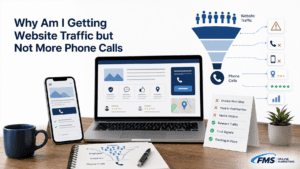
Then there is mobile experience. Most local service searches happen on phones. If your website is slow, your tap-to-call function is clunky, or your contact path is confusing, visibility may still generate traffic without producing leads. That is expensive failure.
How to improve visibility without wasting time
Start with the places where intent is highest. Tighten your Google Business Profile, make sure your core service pages are built around real local search behavior, and create a review system that runs every week. Those three areas usually produce the fastest gains when executed well.
Next, look at your map pack reality instead of your assumptions. Are you appearing for your money terms in your actual service area, or only for branded searches and fringe keywords? Many owners think they are visible because they can find themselves by searching their own company name. That does not mean customers can find them when they need a service.
After that, fix the gaps competitors are using against you. If they have stronger review signals, sharper category targeting, better service pages, and more complete business profiles, you are not losing by chance. You are losing because Google has clearer reasons to trust and rank them.
This is where specialized local SEO beats generic digital marketing. A broad agency may talk about traffic growth. A local search specialist focuses on map visibility, service-area relevance, conversion actions, and lead quality. That is a major difference for businesses that depend on calls and appointments, not vanity metrics.
For companies in competitive service sectors, local visibility also requires consistency. One-time setup helps, but it rarely creates local dominance. Markets shift. Competitors improve. Reviews come in. Search behavior changes. The businesses that keep growing are the ones that keep refining their local presence rather than treating SEO like a checkbox.
Visibility is only valuable when it turns into customers
Being seen is not the final goal. The real goal is becoming the obvious choice when someone nearby is ready to act. That means your visibility has to be backed by trust, clarity, and a simple path to contact your business.
If your company has been burned by weak SEO providers before, that frustration is valid. Many businesses have paid for reports instead of results. But local search still works when the strategy is built around how customers actually find and choose local services. That is why agencies like FMS Online Marketing stay focused on local performance instead of trying to be everything to everyone.
The strongest local businesses are not always the biggest brands. They are the ones that show up consistently, look credible immediately, and make it easy for nearby customers to call, book, or request help. If that is not happening for your business yet, improving your local visibility is not a side project. It is one of the clearest paths to more qualified leads and more revenue.