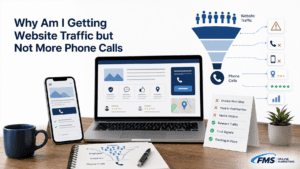
AI search is changing how small business owners are discovered online. Instead of simply displaying a list of website links, AI-driven search engines like Google’s AI Overviews, OpenAI’s ChatGPT Search, and Microsoft Bing Copilot now generate direct, fully developed answers to users’ questions. This seismic shift means that your business needs to be understood by both humans and AI systems to stay visible, trusted, and competitive in your market.
For business owners, especially those who rely on local customers, AI search is a game-changer. It’s not just about showing up near the top of traditional search results anymore. To really succeed, your business information needs to be organized, complete, and trustworthy – so much so that AI tools will quote, summarize, or recommend it.
As experts in local SEO and AI search strategies, FMS Online Marketing is here to help you navigate this changing landscape and keep your business visible in a world driven by search. We’ll show you how to make the most of these new opportunities and challenges, and ensure your business stays front and center.
What Is AI Search?
AI search is a new way of searching that uses smart technology to understand what you’re looking for. It’s like having a personal assistant that can figure out what you mean, not just look for keywords. Traditional search engines just match words to websites, but AI search goes deeper. It tries to understand the meaning and context of your question, so it can give you a straight answer or a summary of what you need to know, instead of just a list of links. This makes it easier to find what you’re looking for, and it’s more like how a person would search for something.
For people who own businesses, things are changing. Now, the things you put online, like information about your business and your website, are looked at in a different way. New search tools that use artificial intelligence try to figure out if they can trust you and if you’re an expert in what you do. They do this by looking at your website, the lists where your business is mentioned, and what your customers say about you. Then, they use all this information to answer questions that people really want to know, and they often do it right in the search results.
Why Does AI Search Matter for Business Owners?
AI search is really important because it affects how people decide what to buy. Did you know that more than half of the time, when you search for something on Google, you’ll see a summary that was created by a computer? And sometimes, this summary shows up even before the regular search results.
This is a big deal for local businesses, because it means they need to make sure they’re included in these computer-generated summaries if they want to be seen by potential customers. If your business is included, you’re more likely to get calls and leads, but if you’re not, you might miss out. It’s like a new competition to see who can get their business in front of people first.
According to multiple studies cited in industry research:
- AI Overviews in Google Search can reduce organic clicks by as much as 38%.
- Zero-click searches (where users get what they need from the summary) have increased from 54% to 72% for the queries where these summaries appear.
- For local business queries, organic click reduction ranges from 15–61% depending on how AI presents the answer.
- These data points highlight that your business not only needs to rank—it must be selected, cited, or summarized favorably by AI.
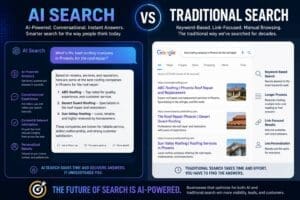
AI Search vs. Traditional Search: Understanding the Shift
| Traditional Search | AI Search |
|---|---|
| Matches keywords and returns links | Understands intent, returns concise answers |
| Ranks websites based on keyword targeting | Ranks and cites clear, trustworthy information |
| Requires users to scan multiple sites | Often answers within the search result |
| SEO is about ranking position | SEO includes being cited or summarized |
For business owners eager to stay ahead, it means your website, service pages, and business profiles must be structured and written in ways that AI can easily recognize, extract, and share.
How to Optimize for AI Search: A Practical Framework
To maximize your business’s visibility in AI-powered search, FMS Online Marketing recommends a structured, step-by-step approach. Here is what works for businesses we’ve served:
- Audit Your Current Visibility
- Search for your business, services, and location on Google, Bing, and AI tools like ChatGPT or Gemini.
- Note whether you appear in direct answers, recommendations, or are left out entirely.
- Correct and Unify Business Information
- Ensure absolute consistency across your website, Google Business Profile, Bing Places, and all local directories.
- This includes your name, address, phone, category, business description, and services.
- Create People-First, Question-Based Content
- Build helpful, clear, and structured web pages that answer real customer questions about your services, pricing, process, and expertise.
- Include FAQ sections—AI systems often draw directly from these areas.
- Use Structured Data and Technical SEO Best Practices
- Implement LocalBusiness schema markup to help search engines understand your business model and services.
- Make your website crawlable to all major crawlers, including OpenAI and Bing.
- Follow Google’s guidelines for structured data and “people-first” content (source).
- Build Trust and Social Proof
- Request reviews on Google, Bing, and industry directories to demonstrate authenticity.
- Highlight accreditations, relevant case studies, and transparent calls to action.
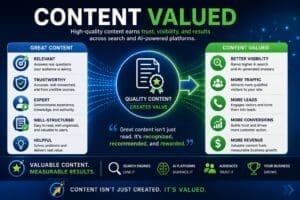
What Type of Content Does AI Search Value?
- Clear headings and structured content (use H1 for page topic, H2 for key sections, H3 for subtopics).
- Short, direct answers under each heading—easy for AI to extract and cite.
- Specific details about your unique services, local area, and expertise.
- Trust signals: customer reviews, certifications, and demonstrable results.
- Location cues: mention your city, neighborhood, or service area.
At FMS Online Marketing, we believe that to really stand out, you need to have a strategy that combines content that answers people’s questions with strong technical SEO. This is because being visible in local search results now depends on being friendly to both humans and artificial intelligence.

Case Example: How AI Search Rewards Local Businesses
A local pest control company was struggling to get noticed online and wasn’t getting many inquiries from potential customers. But after teaming up with FMS Online Marketing, they were able to turn things around.
They started by making sure their Google Business Profile was complete and up-to-date, adding detailed answers to frequently asked questions, and encouraging happy customers to leave reviews. They also cleaned up their website to make it easier for search engines to understand. The results were impressive: the company shot up to the top 3 in local search rankings, saw a huge 200% increase in website traffic, and gained 128% more new customers.
All of this was thanks to the improved local SEO and AI-friendly content. By making these changes, the company was able to reach more people in their area and grow their business.
Many business owners, including those in plumbing, HVAC, auto repair, roofing, and home services, have seen a big jump in how visible they are to customers. We’ve got lots of examples and tips on how to do it in our case studies and guides that are specific to each industry. You can check them out to learn more about how to boost your own business’s visibility.
– How to Use AI for Local SEO: Strategies Small Businesses Can Adopt Now
– FMS Online Marketing Case Studies
Best Practices for Business Owners Competing in AI Search
- Keep your business name, address, phone, and service categories consistent on all profiles and directories.
- Update your Google Business Profile and Bing Places listing with accurate, up-to-date info.
- Create web content that answers practical customer questions quickly and clearly.
- Implement LocalBusiness schema and regular technical audits for SEO health.
- Gather and showcase authentic customer reviews—both quantity and quality matter.
- Regularly monitor your visibility in AI search results using analytics and business intelligence tools.
- Follow Google’s and Bing’s most recent guidance on crawlability and structured data (for more, check Structured Data Markup Overview and OpenAI Publisher FAQ).
Staying Visible: Performance Measurement and Ongoing Action
Visibility in AI search is dynamic. Tools like Google Search Console, Bing Webmaster Tools, and analytics platforms allow you to track how your website and profiles appear in evolving search experiences. As search engines tweak their AI-driven features, continue updating business information, reviewing structured data health, and expanding content that answers customer questions.
Many business owners find that diversifying beyond organic search with strategies like social media, referrals, and email keeps lead flow strong—even as AI search runs more of the online discovery process.

FAQ: AI Search for Business Owners
- How does my Google Business Profile impact AI search visibility?
Optimizing your Google Business Profile (GBP) makes it easier for Google’s AI systems to identify, summarize, and recommend your business for local queries. Ensure consistency, detailed service descriptions, updated photos, and reviews on your profile for best results. Learn more about GBP optimization in What Makes a Great Google Business Profile?
Is AI search only happening on Google?
No. OpenAI’s ChatGPT Search and Microsoft Bing Copilot have launched AI-powered search that uses real-time web data and local business listings. Ensuring accessible, structured content and up-to-date profiles on each platform is critical to remain visible across all search experiences.
How can I measure if AI search is bringing me customers?
While traffic sources have changed (with more zero-click searches), tools like Google Search Console and Google Business analytics still track visibility, calls, and actions. Pay attention to shifts in inquiry volume and which services or answers are helping new customers find you. Many businesses also find value in prompt-level testing for Bing Copilot and reviewing OAI-SearchBot activity in analytics.
Can small businesses compete with big brands in AI-powered search?
Absolutely. AI search frequently draws from detailed, helpful, and locally relevant content—regardless of company size. Focus on clarity, question-driven content, social proof, and accurate profiles to show expertise and trust in your market.
What if my rankings drop because of AI Overviews?
Stay proactive. Update and enhance your business information and web content, monitor where and how you’re cited, and strengthen your Google Business Profile. Diversify your digital marketing to maintain consistent lead flow. Partnering with an expert like FMS Online Marketing can help you adapt seamlessly.
How important are reviews in AI search?
Very important. Both Google and Bing use review volume and sentiment as trust signals. Encourage customers to leave reviews and respond to all feedback professionally.
Preparing Your Business for the Future of Search
The evolution of AI search is not a one-time trend. It fundamentally changes how buyers find, compare, and contact businesses—whether they are searching for a plumber, lawyer, HVAC pro, or auto shop. The strongest businesses will be those who explain what they do clearly, prove their results, keep information consistent, and give both people and AI the answers they need.
At FMS Online Marketing, our goal is to help you stand out in local search results. We want to show you how to use the latest AI technology to your advantage and make the most of the changes in search. By working with us, you can turn these changes into real opportunities for growth that you can measure. Get in touch with our team now to get a personalized plan and a clear path to getting your business seen in local search – a plan that’s designed to work for you, both now and in the future.