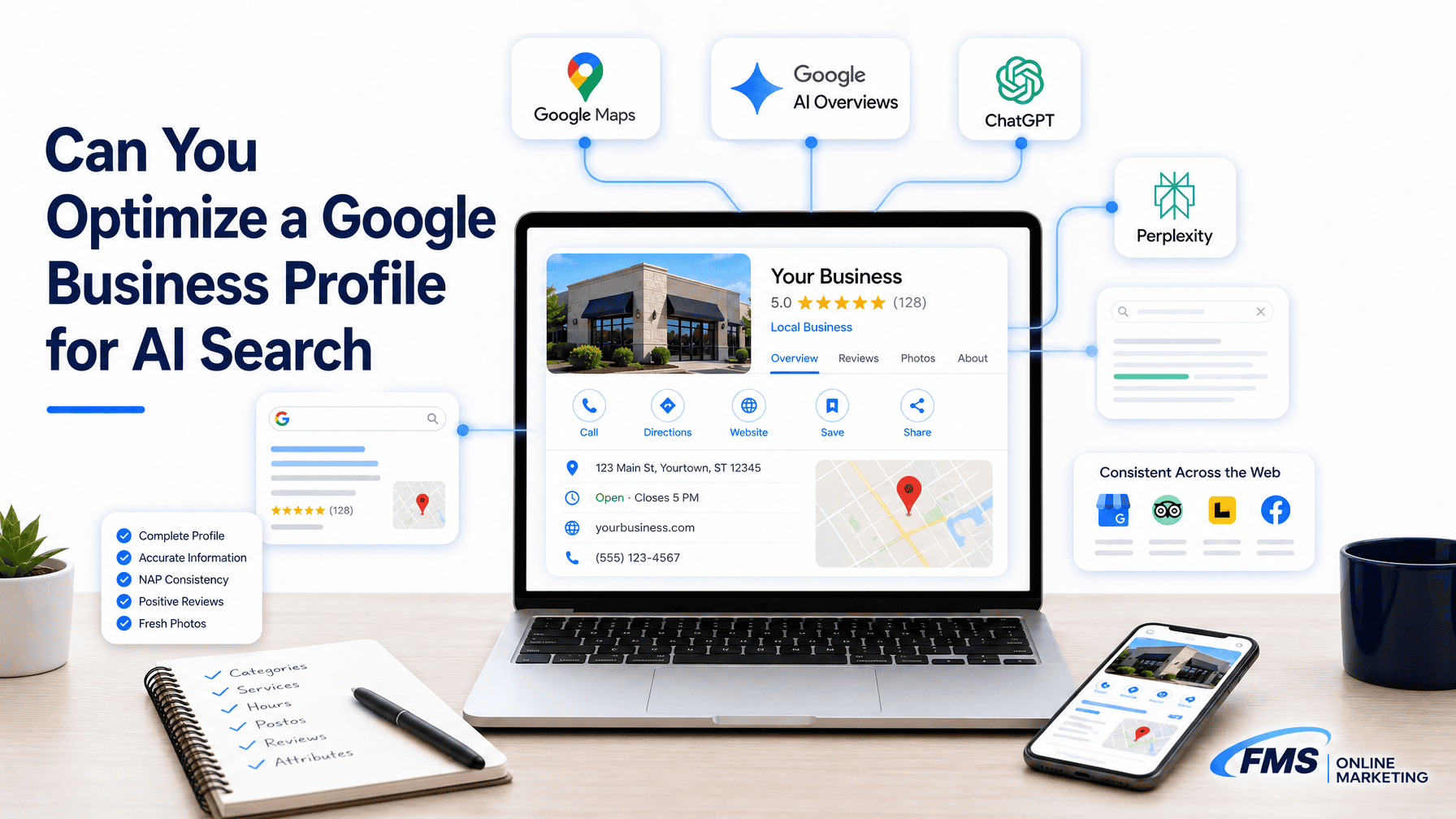
Yes, you can optimize a Google Business Profile to make your business information more complete, accurate, and easier to match with local searches. Google says local visibility is shaped primarily by relevance, distance, and prominence, while its AI Search guidance confirms there are no special AI ranking requirements or schema shortcuts. A stronger GBP can support the broader information systems use, but it cannot guarantee an AI Overview, ChatGPT, or Perplexity mention.
Imagine a customer asks an AI assistant for the best plumber near them. Your Google Maps listing shows the right phone number, but the AI answer pulls outdated hours, lists a service you stopped offering two years ago, or surfaces a competitor instead. That gap is not a mystery algorithm problem. It is usually an information problem.
The real question behind this search is not "what is the secret AI ranking trick for GBP?" It is: can improving my profile help search systems understand what my business does, where it operates, and why it should be trusted? The honest answer is yes, with important limits.
Google Business Profile optimization is useful, but it is one part of a larger local search identity. The profile, your website, your citations, and your reviews all need to form one clear, corroborated record. This guide is a practical framework based on Google's official local ranking guidance and clearly labeled recommendations.
What does AI search need from a local business profile?

AI search is not one system
The term "AI search" covers very different platforms. Google AI Overviews and AI Mode are part of Google's own Search infrastructure. They use the same indexing, ranking, and quality systems that power standard Google Search results. Google's documentation is clear: good foundational SEO remains the right approach, and there are no additional special technical requirements for AI features.
ChatGPT Search and Perplexity work differently. Both describe web crawling and multi-source synthesis to generate answers with citations. Neither platform has publicly documented a direct, universal data feed from Google Business Profile. What they can do is find and summarize information about your business from your website, review platforms, directories, and other indexed sources.
That distinction matters. Optimizing for Google's AI features and optimizing for open-web AI search tools both require accurate, consistent, and findable business information, but the data paths are not identical.
The local business entity must be clear and consistent
AI systems, whether inside Google or across the open web, need to be able to construct a reliable picture of who your business is, what it does, and where it operates. When that picture is fragmented, contradictory, or thin, the system either skips the business or summarizes it inaccurately.
| What the system needs to understand | Where the evidence should appear |
|---|---|
| Business name, type, and category | GBP primary category, website title tags, structured data |
| Services and service areas | GBP services section, website service pages |
| Hours and contact details | GBP hours, website header and contact page, directories |
| Location or service area | GBP address or service area settings, website footer |
| Trust and reputation | Google reviews, third-party directories, response history |
Can you optimize a Google Business Profile for AI search?

What GBP optimization can improve
Yes, google business profile optimization can materially improve how search systems interpret your business. Completeness reduces guesswork. Accurate categories narrow the match to relevant queries. Detailed service entries give AI systems concrete language to work with. Consistent hours prevent contradictions that erode confidence.
Think of the profile as your business's official public record. When that record is complete, accurate, and supported by matching information across your website and directories, systems, including Google's AI features, have strong evidence to work from.
What GBP optimization cannot guarantee
No optimization method guarantees inclusion in a Google AI Overview, a ChatGPT recommendation, or a Perplexity citation. Google's own documentation states that indexing, serving, and ranking are not guaranteed for any page or business. AI platforms reserve the right to decide what appears in any given response.
| You can influence | You cannot control |
|---|---|
| Profile completeness and accuracy | Whether Google features you in an AI Overview |
| Category and service clarity | Distance from the searcher |
| Website and citation consistency | Competitor activity and proximity |
| Review request and response process | Review content written by customers |
| Structured data matching visible content | ChatGPT or Perplexity citation decisions |
Which Google Business Profile fields matter most for AI visibility?
Choose the most accurate primary category
Google's category guidance is direct: categories describe what the business is, not what it wants to rank for. A plumbing company that selects "Plumber" as its primary category gives the system a precise match. Selecting a vague or adjacent category because it sounds broader creates relevance noise.
Secondary categories can describe additional services your business genuinely offers. The stop condition is simple: only add categories that reflect real services you provide. Do not add categories to capture extra keyword coverage.
Describe services, hours, attributes, and service areas precisely
The GBP Services section lets you list individual offerings with descriptions. Use plain language that reflects how customers describe the service, not marketing copy. If you offer emergency HVAC repair, say that. If you serve specific ZIP codes, list those service areas accurately.
Hours accuracy matters both for customers and for AI systems that synthesize business availability into answers. Set special hours for holidays and closures. An AI system summarizing "open until 9 PM" when you close at 5 PM creates a frustrating customer experience that damages trust.
For service-area businesses, hide your address if customers are not served at that location. Set your service area by region or ZIP code, not by radius claims that exceed your real coverage.
Use real business photos and customer-facing details
Google's photo guidance emphasizes real, accurate, well-lit images that represent the business honestly. Photos of your actual team, vehicles, work, or location help customers and search systems validate that the business is legitimate and active.
Attributes, when available for your business type, add specific detail that can match intent-specific queries. A contractor who marks attributes for licensed, insured, and free estimates communicates information that a generic description cannot.
Why must your website and other listings match your GBP?
Build one source of truth for business information
Your GBP is one public record among several. Google's systems, and open-web AI tools, can pull information from your website, Yelp, Facebook, industry directories, and other indexed sources. When those sources disagree, the result is a conflicted entity that systems cannot summarize confidently.
Google's business representation guidelines make clear that business information should reflect real-world facts. NAP consistency, meaning identical name, address, and phone number across platforms, is not a technical formality. It is how systems corroborate that the same real business appears in multiple places.
Use this audit table before adding new content anywhere:
| Data point | GBP | Website | Main directories | Social profiles |
|---|---|---|---|---|
| Business name (exact) | Checked? | Checked? | Checked? | Checked? |
| Phone number | Checked? | Checked? | Checked? | Checked? |
| Address or service area | Checked? | Checked? | Checked? | Checked? |
| Hours | Checked? | Checked? | Checked? | Checked? |
| Services listed | Checked? | Checked? | Checked? | Checked? |
| Website URL | Checked? | N/A | Checked? | Checked? |
Resolve conflicts across directories, social profiles, and industry platforms
Fix conflicts before adding more content. A business that publishes new posts while carrying an outdated phone number in three directories is building on a cracked foundation. Start with your highest-authority listings, such as Yelp, Facebook, Apple Maps, and industry-specific platforms relevant to your vertical.
For industries like legal, medical, dental, HVAC, or roofing, vertical directories often carry significant weight for both traditional local search and as cited sources in open-web AI tools. Keeping those records current is part of the same information hygiene process. For a more comprehensive approach, explore our local SEO services to see how a full citation and consistency audit fits into a broader local visibility strategy.
How do reviews and reputation influence trust?
Request genuine reviews without incentives
Google's review policy is non-negotiable: reviews must reflect genuine customer experiences. Incentivized reviews, fake reviews, copied reviews, and gated review processes all violate policy and risk profile suspension.
The compliant approach is straightforward: ask customers for honest feedback after a positive experience. Make the process easy by providing a direct link. Do not filter customers before sending the link or only ask people you expect to leave five stars.
According to BrightLocal's Local Consumer Review Study, 97% of consumers read online reviews before choosing a local business. That figure alone justifies a consistent, policy-compliant review request process.
Respond to positive, neutral, and negative reviews professionally
Owner responses signal to both customers and search systems that the business is active and engaged. A thoughtful response to a critical review often matters more to prospective customers than the review itself.
Keep responses factual, professional, and free of personal information about the customer. Do not argue in public. Do not copy the reviewer's name or details into the response. Report only reviews that violate Google's content policies, not reviews that are simply negative.
In my view, review management is both a customer experience function and a data-integrity function. Authentic reviews, responded to consistently, form a credible reputation record that supports both traditional local ranking and broader entity trust.
How should you connect GBP optimization to local SEO?
Align service pages and location content
The GBP does not stand alone. It is one node in a local entity system that includes your website's service pages, location or service-area content, contact information, and internal linking structure.
Service pages that describe actual services in plain language give search systems additional corroborating detail beyond the profile. A well-structured service page for "residential HVAC repair in Scottsdale" reinforces what the GBP already says about that service and location. Mass-produced city pages with no unique content do the opposite: they dilute trust and may create indexing problems. Our local search ranking guide covers how relevance, distance, and prominence interact across the full local visibility framework.
To connect your profile work to a stronger foundation, link our local SEO services for a broader look at how service pages, location content, and citation work combine.
Add appropriate LocalBusiness structured data
Google's LocalBusiness structured data documentation explains how markup can describe business details on your website. The important constraints are:
- Structured data must match what is visibly on the page.
- There is no special AI schema requirement. Google's documentation confirms that foundational SEO remains the correct approach.
- Do not add LocalBusiness markup to an article page simply to imply the article is a business listing.
Useful structured data for a local service business includes name, address, telephone, opening hours, service area, and the specific business type, such as Plumber, Dentist, or RoofingContractor.
Make contact and conversion paths easy on mobile
Most local search happens on mobile. A profile that generates interest but points to a website where the phone number is buried, the contact form fails on small screens, or the page loads slowly creates a conversion gap that no amount of profile optimization can fix.
Clear click-to-call buttons, visible address or service-area information, and fast mobile load times are not optional extras. They are part of the same local visibility foundation as the profile itself.
A practical AI-search optimization checklist
Use this as an audit worksheet. Fix identity and policy issues before adding more posts or location pages. For a full audit of your profile, website, citations, reviews, and lead tracking, see our local SEO audit checklist.

Step 1: Verify ownership, eligibility, and business identity
- Claim and verify the GBP with accurate real-world business information.
- Confirm the business name matches legal or operating name with no added keywords.
- Confirm the business meets Google's eligibility requirements for in-person customer contact.
- Check for duplicate profiles and request removal of any you find.
Step 2: Audit categories, services, hours, location, and service area
- Select the most accurate primary category that describes the core business.
- Add secondary categories only for real additional services.
- Complete the services section with accurate descriptions.
- Set regular and special hours. Update for holidays and temporary closures.
- Confirm service area settings or address visibility match your actual operations.
Step 3: Compare GBP information with the website and citations
- Verify business name, phone, address or service area, hours, and services match across the website, main directories, and social profiles.
- Fix any conflict before publishing new content.
- Confirm the website URL in GBP points to the correct, live page.
Step 4: Review photos, reviews, responses, and policy risks
- Add real, accurate photos of the team, location, vehicles, or work.
- Confirm all photos comply with Google's content policies.
- Review your review request process for policy compliance.
- Respond to recent reviews, both positive and negative.
- Remove or report any reviews or photos that violate policy.
Step 5: Record baseline visibility and customer actions
- Record current GBP performance metrics: searches, views, calls, direction requests, and website clicks.
- Note Google Search Console impressions and clicks for branded and nonbranded queries.
- Set a review date on the calendar to check again in 30 to 60 days.
How can you measure AI search visibility without a ranking guarantee?

Track Google Search, Maps, and profile actions separately
GBP performance data shows how many customers called, clicked for directions, or visited your website from the profile. Google Search Console separates branded from nonbranded impressions and clicks. Neither tool provides a direct "AI citation count," but together they give you a picture of whether profile visibility is generating real customer actions.
| Metric | Source | Interpretation | Limitation |
|---|---|---|---|
| Profile views and searches | GBP Performance | How often the profile appeared | Does not separate AI surface from standard Maps |
| Calls, direction requests, website clicks | GBP Performance | Actual customer actions | Attribution is not always traceable to a specific query |
| Impressions and clicks | Google Search Console | Organic search visibility | Does not isolate AI Overviews |
| Branded vs. nonbranded queries | Search Console | Awareness and discovery trends | Sample-based data |
| AI Overview mentions | Manual sampling | Observable citation check | Not a stable ranking metric |
Sample AI answers with a repeatable prompt and location method
For ChatGPT Search, Perplexity, or Google AI Overviews, you can run manual sampling to observe whether your business is mentioned. Record the following each time:
- Exact prompt used
- City and device
- Logged-in or logged-out status
- Date and time
- Result: was the business mentioned, and was it cited with a source link?
Treat this as an observation log, not a ranking report. AI responses vary by session, location, and prompt phrasing. A single mention is not evidence of stable AI visibility.
When is professional GBP or local SEO help worth considering?
Signs the issue is bigger than one profile
Some businesses can manage GBP well internally. Others hit a point where the complexity outgrows a part-time effort. Consider professional help when:
- Ownership or verification access is unclear or contested.
- Business information conflicts across more than a few platforms.
- The business operates in multiple locations or has a complex service area.
- Reviews arrive faster than responses can be managed compliantly.
- GBP data exists in reporting but does not connect clearly to calls or leads.
When FMS Online Marketing may be a fit
This guide is published by FMS Online Marketing and includes discussion of FMS services. Use the criteria below to compare any provider, including FMS.

FMS Online Marketing is a Waddell, Arizona-based local SEO agency serving small businesses across the United States, with a strong Phoenix-area focus. The agency's work covers Google Business Profile optimization services, Google Maps optimization, reputation management, localized content, reporting, and AI-informed search visibility.
A good-fit engagement looks like this: a business with accurate, verifiable real-world information, a genuine desire for compliant local visibility, and a need for documented reporting that connects profile activity to business outcomes.
Before hiring anyone, review the questions to ask before hiring a local SEO company to evaluate scope, ownership rules, reporting transparency, and limitation disclosures.
When this is not the right fit
GBP optimization is not the right starting point for every business. Online-only businesses, businesses that cannot make in-person customer contact during stated hours, and businesses that cannot provide accurate real-world information are not eligible for a Google Business Profile under Google's guidelines.
If your profile contains unresolvable eligibility issues, fix those before investing in optimization. If lead volume is weak but the profile and website are both accurate and well-structured, the issue may be service-page depth, mobile conversion paths, or local market competition rather than the profile itself.
Frequently Asked Questions
Can you optimize a Google Business Profile for AI search?
Yes, but optimization means improving accuracy, completeness, consistency, and clarity. No optimization guarantees AI visibility or a citation in any AI platform.
Does Google Business Profile affect Google AI Overviews?
GBP can support Google's understanding of a local business, but Google does not guarantee that an optimized profile will appear in an AI Overview for any query.
Does GBP optimization make ChatGPT recommend my business?
No specific optimization guarantees a ChatGPT recommendation. GBP is one part of the broader public information that may help describe your business when ChatGPT Search crawls the web.
Is there special schema for AI search?
No. Google's documentation confirms there are no special AI schema requirements. Use valid LocalBusiness structured data that matches your visible page content.
Which GBP fields should I optimize first?
Start with eligibility, business identity, primary category, services, hours, location or service area, website URL, and phone number. These are the foundation everything else builds on.
Do reviews help with AI search visibility?
Genuine reviews contribute to Google's prominence signals and customer trust. No specific review count guarantees AI visibility, and policy-violating reviews can harm the profile.
Should a service-area business hide its address?
Yes, if customers are not served at your physical address. Follow Google's service-area guidance and remove the public address to avoid representing an unsupported location.
How often should a Google Business Profile be updated?
Update the profile whenever business facts change: new hours, new services, new phone number, or temporary closures. Review it on a documented schedule. A specific posting frequency does not have an officially confirmed ranking benefit.
How can a small business measure AI search visibility?
Track GBP performance data and Google Search Console first. For AI-specific mentions, use repeatable manual sampling with a documented prompt, location, device, date, and result.
When should I hire a GBP or local SEO agency?
Consider it when information conflicts across platforms, ownership is unclear, the business has multiple locations or complex service areas, or reporting does not connect profile visibility to actual leads.
What should you do first after reading this guide?
Here is a simple decision framework:
- If the profile contains incorrect or incomplete facts, fix eligibility, identity, categories, services, hours, and location first.
- If the profile is accurate but the website and citations disagree, resolve those conflicts before publishing more content.
- If the profile and website are aligned but leads remain weak, inspect service-page depth, mobile conversion paths, review quality, and your measurement baseline.
- If the business lacks time or internal expertise, consider a documented GBP or local SEO audit.
If your GBP, website, and public business information do not align, a structured local visibility audit can show what to fix first. Contact FMS Online Marketing to start that conversation.
Google Business Profile features and AI search behavior can change. Official documentation and platform behavior were checked in October 2026, but no optimization method guarantees inclusion, rankings, or recommendations.