If you run an established roofing company, you know what one good estimate can be worth.
You also know how quickly paid leads add up. For the search term “seo for roofing companies,” a keyword tool estimates a Google Ads click at about $105.
That isn’t a fixed price for every roofing ad or market. But it makes the point: if every qualified homeowner click has to be bought, the cost can stack up fast.
SEO is a different investment. You pay for the work to improve your visibility, not for each organic click. It takes time, and nobody can promise a specific ranking or number of calls. The question is whether the work is building a stronger source of roofing leads over time.
Where do roofing customers find contractors online?
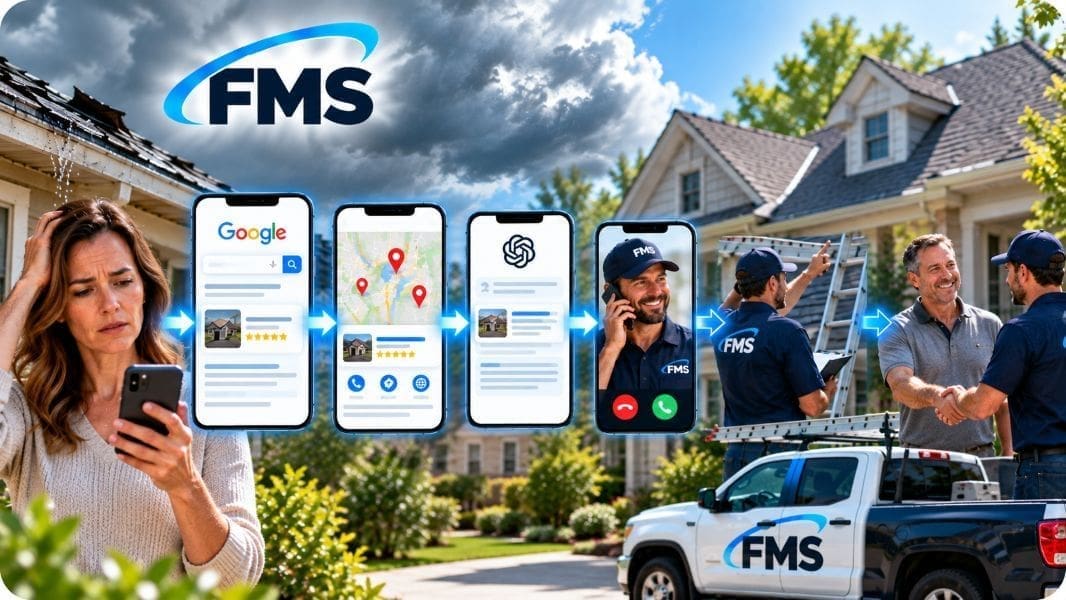
Homeowners searching for “roof repair near me,” “roof replacement in Peoria,” or “storm damage roofer” may see a few different results:
- Google Maps local pack: A map and a short list of nearby businesses. Your Google Business Profile (GBP), reviews, website, and how close you are to the searcher can all matter.
- Organic results: Website pages that match the service and location the homeowner searched for.
- AI answers: Search tools may summarize businesses and local information. Building a clear, consistent online presence can help platforms understand what you do, but no company can guarantee an AI recommendation.
Google says local results are mainly based on relevance, distance, and prominence. You can’t control where every searcher is standing, but you can make your business information clearer and build a more credible presence. Google’s local ranking guidance explains these factors.
For a roofer, the goal isn’t simply to rank for “roofing.” It’s to show up for the right service, in the right area, and give a homeowner a good reason to call.
What actually moves the needle for roofing SEO?
Good roofing SEO starts with the basics that help search engines and homeowners understand your business.

1. Set up your Google Business Profile for the roofing work you do
Choose accurate categories and describe your actual services. Repair and replacement are different needs. Storm damage, commercial roofing, and residential roofing may also require distinct service details.
Don’t add categories or services you don’t offer just to chase more searches. Keep your address or service-area details accurate and follow Google’s business profile guidelines.
A complete profile helps customers quickly check what you do, where you work, your hours, photos, and reviews. Learn more about Google Business Profile optimization.
2. Build service and city pages around real searches
A homeowner looking for a roof replacement in Glendale has a different need from someone searching for emergency leak repair in Scottsdale.
Your website should make those services easy to understand. Create useful pages for your important services and service areas, but don’t publish dozens of near-identical pages with only the city name changed. Explain what you do, where you do it, and how a homeowner can request an estimate.
This is a core part of local SEO for roofers: matching your website to the places and services that matter to your business.
3. Earn reviews that help homeowners make a decision
Ask customers for honest feedback after a completed job. Make the process simple and consistent, and never offer a reward in exchange for a review.
Reviews can build confidence when a homeowner is comparing contractors. Specific, genuine comments about communication, cleanup, repairs, or a replacement project are more useful to a prospective customer than a review that only says “great job.”
4. Show real completed work
Use current photos of your crews, completed roofs, materials, and job sites, with the customer’s permission. Real project photos help homeowners see the work you do and give your profile and website a more authentic feel.
Keep photos accurate. Don’t imply that a photo is your work if it isn’t.
5. Make it easy to call from a phone
Roofing searches often happen on a mobile device. Check that your site loads reliably and that the phone number is easy to tap. Put clear calls to action near the top of important service pages, and make estimate request forms short enough to complete on a phone.
A ranking is only useful if a homeowner can reach you.
6. Keep your business listings consistent
Your business name, phone number, website, and address or service-area information should be accurate across important directories. Fix outdated or duplicate listings where you can. Don’t confuse activity with volume: submitting your details to piles of low-quality directories is not a substitute for a sound local presence.
What does not move the needle?
Some SEO work looks busy without making it easier to win the right jobs.
- Keyword stuffing: Repeating “roofing company Phoenix” unnaturally makes pages harder to read and doesn’t create a better customer experience.
- Generic blog posts with no local intent: A long article about roofing materials may be useful in some cases, but it won’t necessarily help you reach a homeowner looking for a roofer in your service area.
- Directory spam: Hundreds of weak or irrelevant listings won’t replace accurate core business information, good service pages, and real customer feedback.
- Rankings without call tracking: A chart showing improved positions doesn’t tell you whether the right people called, requested an estimate, or booked a job.
Ask your SEO company to connect the work to leads and booked estimates where possible, not just traffic and rankings.
What could paid clicks cost over 12 months?
The table below is illustrative math, not a forecast or promise. It holds the estimated $105 click cost constant to make the arithmetic easy. Actual ad costs vary by keyword, location, competition, and auction conditions. It also assumes the full spend goes to clicks and excludes management fees.
| Paid clicks per month | Illustrative monthly ad spend | Illustrative 12-month ad spend | Clicks in 12 months |
|---|---|---|---|
| 10 | $1,050 | $12,600 | 120 |
| 25 | $2,625 | $31,500 | 300 |
| 50 | $5,250 | $63,000 | 600 |
SEO doesn’t have a fixed cost per organic click, but it does require ongoing work and investment. The number of visits, calls, and booked jobs it produces varies by market, competition, website, and execution. Use the table to ask a better question: what will the work cost, what will it include, and how will we know if it is bringing in qualified opportunities?
What should you ask a roofing SEO company before signing?
Use this checklist when you’re evaluating a roofing SEO company:
- Which roofing services and cities would you prioritize, and why?
- What work will you complete in the first 90 days?
- How will you track calls, estimate requests, and booked jobs?
- Will I see the difference between organic calls and paid advertising calls?
- What will you report each month, and will you explain it in plain English?
- Who will I speak with about the strategy and results?
- What happens if I want to stop working together?
Be cautious if the answers rely on guaranteed rankings, vague deliverables, or a report full of charts with no connection to customer calls.
At FMS Online Marketing, clients work directly with founder Matt Deloff, who has 17+ years of experience. The focus is on calls and booked jobs over vanity rankings, with plain-English reporting. After an initial 90-day foundation period, work continues month-to-month without a long-term contract.
How long does roofing SEO take?
Many businesses see some movement in 60–90 days, depending on the market and competition. A crowded market or a website with major issues can take longer. Early movement does not guarantee a certain number of calls or jobs.
No one can guarantee your roofing company a specific Google position, or a recommendation in an AI answer. A useful plan should explain what work is being done, how progress will be measured, and what you can reasonably expect to learn along the way.
For an example of what a broader campaign can look like, see this roofing company case study. Its results are specific to that business and are not a promise of the same outcome for another roofer.
Want a plain-English look at your profile?
Start with your Google Business Profile. Are your categories, services, service areas, hours, reviews, and photos accurate and helpful to a homeowner?
If you’d like an outside view, FMS can provide a plain-English review of your profile and explain what may be worth improving. No pressure, just a practical place to start.
Roofing SEO FAQs
Is SEO worth it for a roofing company?
It can be, especially if your business wants to build a more durable source of local visibility rather than rely only on paid clicks or shared leads. The return depends on the work, competition, and whether the search traffic turns into profitable jobs.
Do I need a separate page for every roofing service?
Create dedicated pages for important services when you can provide useful, distinct information. Avoid thin pages that simply repeat the same copy with a different service or city name.
Can an SEO company guarantee roofing leads?
No. A company can explain its work, track performance, and adjust its strategy, but it cannot guarantee search rankings, AI recommendations, or a specific number of leads.