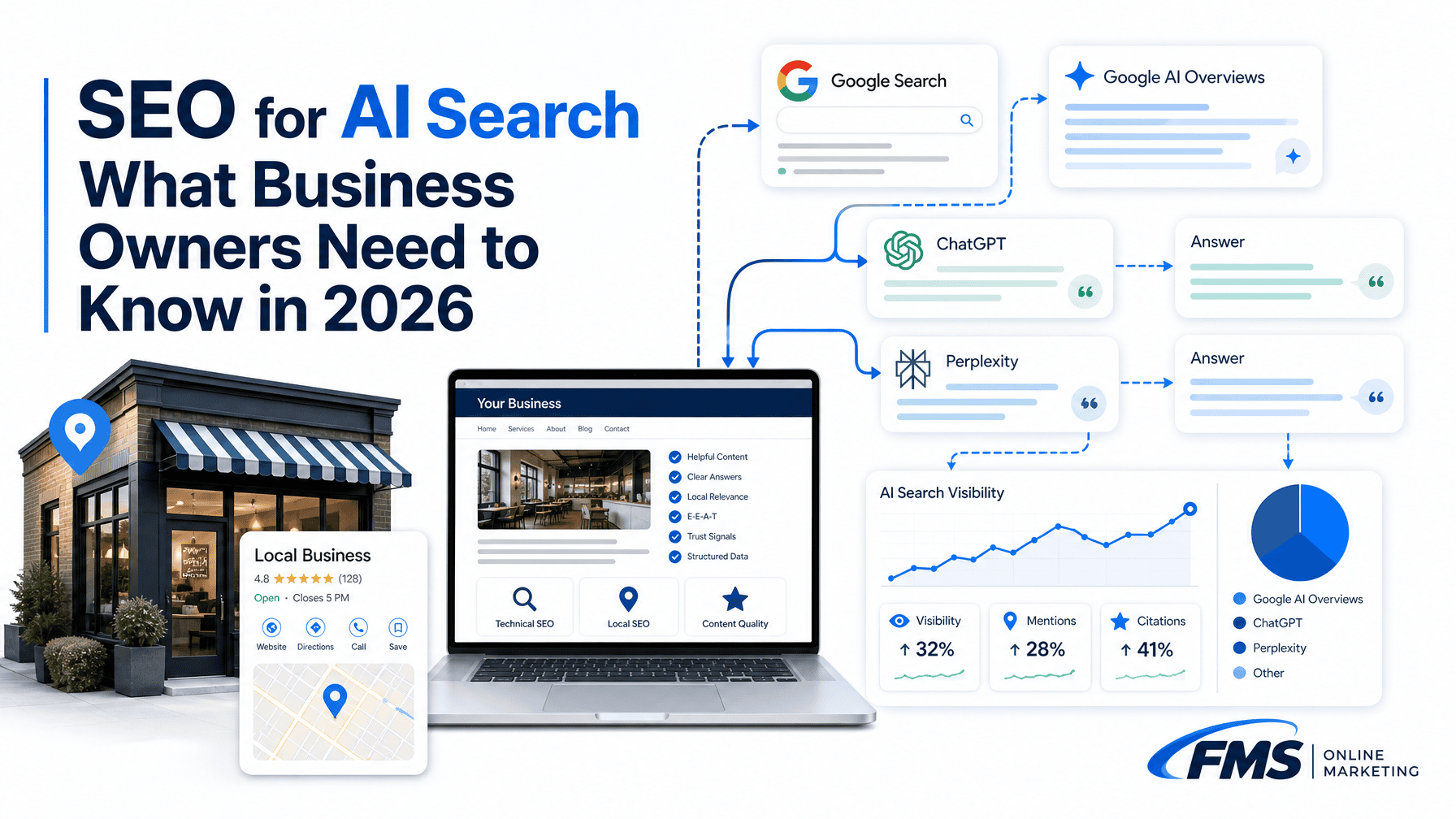
SEO for AI search in 2026 is still built on crawlable, useful, trustworthy content, but the goal is broader: make your business easy for AI systems to understand, verify, and potentially cite. Start with accurate business information, strong service and location pages, genuine reviews, and clear answers. Google states that existing SEO fundamentals remain relevant and that there are no special AI-only technical requirements for AI Overviews or AI Mode. No platform can guarantee that it will recommend your business.
You check your Google rankings and things look steady. But a customer calls and says they found a competitor through a ChatGPT recommendation. Another asks why your business isn't showing up in an AI summary when they search for a service you've offered for years. It's disorienting, and it raises a fair question: what do you actually need to do differently?
The real question isn't "How do I trick ChatGPT?" It's a more practical one: can search systems clearly understand what you do, where you operate, who you serve, and why customers should trust you? That's the foundation of AI search visibility, and it's more attainable than most guides make it sound.
Google's current guidance keeps foundational SEO at the center of AI search optimization. What AI search adds is a new set of answer interfaces, discovery experiences, and measurement signals that sit on top of those same fundamentals. This guide walks through what's changed, what still matters, and how to build a practical plan, not a guarantee.
Is AI SEO Different from Traditional SEO?
AI search refers to the growing set of experiences where a search engine or AI assistant synthesizes an answer rather than returning a simple list of links. Google's AI Overviews and AI Mode, ChatGPT search, and Perplexity are the most visible examples in 2026.
Industry terms like Answer Engine Optimization (AEO) and Generative Engine Optimization (GEO) describe attempts to appear in these synthesized answers. Google, however, frames optimization for its own generative features as part of Search optimization, not a separate discipline. Their documentation is direct on this point: generative AI features on Google Search are rooted in core Search ranking and quality systems.

The practical distinction is this: traditional SEO focuses on ranking a page. AI search adds the goal of being understood and potentially cited by an AI system that may generate an answer for the user without them clicking through. Those are different success metrics, but the input, your content quality, site accessibility, entity clarity, and business credibility, stays largely the same.
| Dimension | Traditional SEO | AI Search Optimization |
|---|---|---|
| Primary goal | Rank pages in search results | Be understood, indexed, and potentially cited in AI answers |
| Content format | Keyword-focused, comprehensive | Direct answers, clear structure, supported claims |
| Visibility metric | Rankings, organic clicks | AI impressions, organic clicks, branded searches, qualified leads |
| Technical requirements | Crawlability, indexation, page experience | Same as traditional SEO; no additional AI-only markup required |
| Measurement tool | Google Search Console (standard) | Google Search Console (including generative AI report, as of August 31, 2026) |
What AI Search Changes for the Customer Journey
Consider a homeowner whose heat stops working in January. They open their phone and ask an AI assistant: "Who's the best HVAC company in my area?" The AI might generate a summary naming two or three providers, explain what to look for in an HVAC company, and offer a follow-up like "Would you like to see reviews?"
That customer may never scroll through a traditional search results page. They're moving from a broad problem question to a provider recommendation to a trust-verification step, all inside one conversation. If your business information is inconsistent, your service pages are vague, or your reviews are sparse, an AI system has less to work with when evaluating whether to surface your business in that answer.
Which AI Search Platforms Matter for Small Businesses?
Not every AI platform deserves equal attention. Here's a practical breakdown of where small businesses should focus, based on what each platform actually does and what the official documentation supports.
| Platform | What the user sees | Business information to clarify | What to monitor | Evidence status |
|---|---|---|---|---|
| Google AI Overviews | A synthesized summary above organic results, with source links | Service pages, GBP, structured data, reviews | Generative AI impressions in Search Console | Confirmed via Google Search Central |
| Google AI Mode | A conversational, multi-turn search experience within Google | Same as AI Overviews; same indexing requirements | Generative AI impressions (combined with AI Overviews in Search Console as of September 2026) | Confirmed via Google Search Central |
| ChatGPT search | Web-cited answers with source links; uses approximate location for local results | Accessible website, accurate business info; requires OAI-Searchbot access | Manual prompt tests, referral traffic from ChatGPT | OpenAI documentation; placement not guaranteed |
| Perplexity | AI-generated answers with cited sources | Accurate, accessible, well-structured content | Manual prompt tests | No verified official documentation in our evidence pack; verify current platform docs directly |
Platform features and reporting details were checked in October 2026 and may change.
Should a Business Optimize for Google AI Overviews, ChatGPT, or Perplexity First?
Start with the platform your customers are most likely to use for your service category and location. For most U.S.-based small businesses, that means Google's AI features first, since they're tied directly to the same index and ranking systems your existing SEO already supports.
Strengthening the shared foundation, solid content, accurate business data, crawlable pages, and genuine reviews, will carry over to every AI platform. Don't fragment your effort trying to game each assistant individually.
What SEO Foundations Still Matter in AI Search?
Google is clear: no special AI-only files, markup, or schema types are required for AI Overviews or AI Mode. The same foundations that support traditional search eligibility support AI feature eligibility. Here's what that actually means in practice:
1. Crawlability and indexation. If your pages are blocked by robots.txt, marked noindex, or simply not crawled, AI visibility cannot compensate. Start there. Use Google Search Console's coverage report to confirm your priority service and location pages are indexed.
2. Helpful, people-first content. Google's guidance asks whether content was created primarily to help people rather than to rank. That standard applies whether AI tools helped draft the content or not. Content must be reviewed, verified, and genuinely useful before publishing.
3. Consistent business information. Your name, address, phone number, hours, service areas, and categories should match across your website, Google Business Profile, and key directories. Inconsistency creates ambiguity that search systems, and AI systems, cannot easily resolve.
4. Internal links and page architecture. Clear internal links connect your informational content to relevant service and location pages. This supports topical authority and helps search systems understand the relationship between your content.
5. Structured data that matches visible content. LocalBusiness structured data can help Google interpret your business details, but it does not guarantee a rich result, an AI citation, or a recommendation. Validate your markup and make sure it reflects what's actually on the page.
Does Structured Data Make a Business Appear in AI Answers?
No. Structured data can help Google interpret eligible business information, but it does not force an AI Overviews appearance, a rich result, or a recommendation from any platform. Add it for clarity and validation, not as a visibility guarantee. Always make sure the markup matches your visible page content.
How Should You Optimize Content for AI Search?
The most common mistake I see is content that buries the answer. A page titled "HVAC Services in Phoenix" that opens with three paragraphs of company history before explaining what the company actually does is hard for search systems to evaluate and harder for customers to trust.
Here's a simple editorial test for every piece of content: could a reader verify this statement, understand its limitation, and know what to do next? If not, the content needs more work.
Practical writing framework for AI search:
- Answer the core question early. Put the most useful information in the first paragraph, not after the backstory.
- Use descriptive headings. "How long does HVAC installation take?" is more useful than "Our Process."
- Explain tradeoffs and qualifications. AI systems and readers both trust content that acknowledges limits.
- Add original judgment. Share how you evaluate a decision, not just what the options are.
- Connect informational pages to service pages. An article about HVAC maintenance should link to your HVAC service page naturally.
- Keep paragraphs short and specific. Three sentences maximum, with line breaks between separate thoughts.
Google's guidance on helpful content emphasizes unique, non-commodity information. That standard should shape every page you publish or update.
How Do I Write Content That AI Systems Can Confidently Cite?
Write clear, specific information supported by trustworthy sources and visible proof. No particular sentence structure guarantees citation. The content checklist that matters:
- Answer: State the direct answer to the question early.
- Context: Explain why it's true and what conditions apply.
- Proof: Link to or name the supporting source.
- Limitation: Acknowledge what the answer doesn't cover.
- Next step: Tell the reader what to do or where to go.
How Local SEO Supports AI Search Visibility
For local businesses, AI search visibility is fundamentally an entity consistency problem. An AI system evaluating whether to include your plumbing company in an answer about "reliable plumbers in Scottsdale" is working from the information it can find and verify about you. If that information is inconsistent or thin, the answer is easy: skip it.

Local SEO strategies built around entity clarity directly support this. Here's the five-step workflow I recommend:
- Verify your business facts. Name, address, phone number, service categories, service area, and hours should be confirmed as accurate before anything else. These are the facts an AI system is most likely to surface.
- Align your core pages. Your homepage, service pages, and location or service-area pages should tell a consistent story about what you do and where you do it. Vague or duplicate content creates confusion.
- Maintain your Google Business Profile. An accurate, complete Google Business Profile optimization supports how your business is represented across Google Search and Maps. Google notes that Business Profiles help manage how business information appears across those surfaces.
- Earn genuine reviews. Descriptive reviews that mention specific services and locations add credibility signals. Avoid incentivized or fake reviews, which violate platform policies and can damage trust.
- Monitor for accuracy errors. Set a recurring reminder to check your listings, GBP, and website for outdated hours, wrong phone numbers, or service changes. Errors compound quickly across platforms.
Can Google Business Profile Help with AI Search Visibility?
An accurate Business Profile supports how your business is represented across Google Search and Maps. It does not guarantee an AI recommendation. The distinction matters: information accuracy makes you a credible candidate for AI features; platform selection depends on factors beyond your direct control. Maintain your profile because it improves local discovery, not because it triggers AI citations.
What Should Business Owners Measure in AI Search?
AI mentions are a diagnostic signal, not a business outcome. The outcome is a qualified phone call, a form submission, or a booked appointment. Build your measurement model around both.

As of August 31, 2026, Google's generative AI performance reports have rolled out to all verified properties worldwide. The reports cover impressions from AI Overviews, AI Mode, and generative AI features in Discover, broken down by page, country, device, and date. Click data is not currently included. These reports cover Google's generative AI features only and should not be treated as a cross-platform AI visibility measure.

| Metric | What it tells you | Where to get it | Limitation | Review cadence |
|---|---|---|---|---|
| Generative AI impressions | How often your pages appear in Google AI features | Search Console generative AI report | Google only; no click data yet | Weekly |
| Organic clicks and queries | Which pages drive search traffic | Search Console standard report | Does not separate AI-assisted clicks | Weekly |
| Branded search volume | Whether people are searching your name directly | Search Console, Google Analytics | Indirect signal; many factors affect it | Monthly |
| Qualified calls and inquiries | Whether visibility translates to real leads | Call tracking, CRM, contact forms | Attribution is imperfect | Weekly |
| Manual AI prompt log | Whether named platforms mention your business | Your own documented test with date and location | Platform outputs change; not a ranking | Monthly |
How Can a Small Business Track AI Search Visibility?
Combine Google's generative AI performance reporting with a repeatable manual prompt log. For the manual log, record the date, your location, the exact prompt used, each platform tested, business mentions, competitor mentions, cited sources, any factual errors, and your next corrective action. If you run live tests and publish the results, disclose the methodology including date, platform version if visible, location, and what was recorded.
Common AI SEO Mistakes Business Owners Should Avoid
Here's what I see businesses waste time and money on, and the direct correction for each:
| Mistake | Why it fails | Correction |
|---|---|---|
| Publishing unreviewed AI-generated content at scale | Google's policies apply regardless of how content is created; thin or unhelpful content can harm visibility | Edit, verify, and add original value before publishing |
| Chasing every AI acronym (AEO, GEO, SGE) | Terminology changes faster than platform behavior | Focus on the shared foundation: useful content, accurate data, strong entity clarity |
| Claiming guaranteed AI recommendations | No platform guarantees inclusion; OpenAI explicitly states placement is not guaranteed | Set realistic expectations and measure qualified leads, not promises |
| Inconsistent business information | AI systems, like search engines, struggle with conflicting signals | Audit and align NAP, categories, hours, and service areas across all platforms |
| Optimizing for a platform your customers don't use | Effort without audience match produces no business outcome | Understand where your customers actually search before allocating effort |
| Measuring mentions instead of lead quality | A ChatGPT mention with no qualified call is vanity data | Connect AI visibility tracking to conversion tracking from the start |
A Practical 90-Day AI Search Action Plan
Ninety days is a planning window, not a guaranteed results period. Timelines depend on your market, competition, current technical health, and content quality. Use this as a structured starting point, not a promise.

| Phase | Timeline | Key actions | Output | What to measure |
|---|---|---|---|---|
| Foundation | Days 1 to 30 | Audit crawlability and indexation; verify business facts across website, GBP, and directories; review core service and location pages; document existing AI prompt visibility; confirm conversion tracking | Baseline audit report and prompt log | Coverage status, GBP completeness, indexed pages, conversion path quality |
| Improvement | Days 31 to 60 | Fix high-impact information gaps; improve two to three priority service pages with direct answers and evidence; strengthen internal links; validate LocalBusiness structured data; improve review-response workflow | Updated pages, structured data report, internal link map | Search Console impressions, generative AI impressions, qualified calls |
| Expansion | Days 61 to 90 | Publish or improve one to two supporting resources (FAQ page, service-area page, or location guide); repeat prompt tests; compare query match and lead quality with baseline; prioritize next corrections | New content, updated prompt log, performance comparison | Branded search movement, inquiry quality, assisted conversions |
FMS Online Marketing publishes this educational guide and offers SEO, Local SEO, AI SEO, AEO, GEO, and Google Business Profile services.
If you'd like a structured approach to this plan, the AI SEO services and SEO services at FMS cover the audit, content improvement, GBP management, structured data validation, and measurement setup that make this work in practice.
When Should a Business Get Professional AI SEO Support?
Professional support makes sense when the work outpaces internal capacity or expertise. Specifically, it tends to fit businesses that:

- Have multiple locations or complex service areas with inconsistent business information
- Lack internal bandwidth to audit, update, and monitor content and business listings consistently
- Have technical barriers like slow pages, crawl errors, or broken internal link structures
- Need to connect search visibility to qualified leads and conversion data, not just rankings
- Want a structured approach to Google Business Profile management, content, and measurement
It's a worse fit when a business hasn't clarified its core services, can't supply accurate business facts, expects guaranteed AI recommendations, or wants a shortcut that skips the foundational work.
When evaluating any agency, ask these five questions:
- What specific changes will you make to my website and business listings?
- How do you verify the accuracy of claims before publishing?
- What will you measure, and how will you connect it to qualified leads?
- What is excluded from your service scope?
- How do I retain access to my accounts and data if we stop working together?
When FMS Online Marketing Is Not the Right Fit
FMS works with established service-based businesses that want a customized strategy and are willing to supply accurate business information and cooperate in the process. FMS does not guarantee AI recommendations, cannot promise a fixed timeline for results, and is not the right fit for businesses that want a quick shortcut or expect immediate rankings without foundational work. Timing depends on the market, competition level, and current online presence.
Frequently Asked Questions
What is SEO for AI search?
SEO for AI search means applying sound SEO and entity-clarity practices so that AI-powered search experiences such as Google AI Overviews, ChatGPT search, and Perplexity can understand and potentially reference your business. The goal is to be understood and verifiable, not just ranked.
Is AI SEO different from traditional SEO?
It overlaps heavily. The same crawlability, content quality, and authority signals that support traditional rankings also support AI feature eligibility. The search interface, answer format, and some visibility metrics differ, but the input requirements are largely the same.
How do I get my business recommended by ChatGPT?
There is no guaranteed submission or recommendation path. OpenAI states that placement is not guaranteed. Focus on clear, accessible, verifiable business information and make sure OAI-Searchbot can crawl your site. Keep expectations realistic.
Can Google Business Profile help with AI search visibility?
An accurate GBP supports how your business information appears across Google Search and Maps. It does not guarantee an AI recommendation. Maintain it for local discovery accuracy, not as an AI citation trigger.
Does structured data improve AI search visibility?
Structured data can clarify eligible information for search engines, but it does not guarantee rankings, rich results, or AI citations. Add it for interpretation accuracy and validate that it matches your visible page content.
What should a local business optimize first?
Start with crawlability, accurate business information, core service pages, Google Business Profile completeness, conversion tracking, and genuine reputation signals. Get the foundation right before expanding into content programs or new platforms.
How do I track AI search visibility?
Combine Google's generative AI performance reporting in Search Console with a dated, repeatable manual prompt log across relevant platforms. Connect both to your conversion and call data for a complete picture.
Does AI-generated content help SEO?
AI assistance can support content creation, but it is not a substitute for helpful, original, verified content. Google's Search policies apply regardless of how content is created. Review and verify everything before publishing.
How long does AI SEO take?
No universal timeline applies. Technical corrections, content improvements, competition level, platform changes, and your existing authority all affect timing. Treat 90 days as a structured planning window, not a promised outcome.
Should I hire an AI SEO agency?
It depends on capacity, complexity, and expectations. If you have multiple locations, technical barriers, or need measurement connected to qualified leads, professional support can accelerate progress. If you expect guaranteed results or haven't clarified your core services, the foundational work comes first.
Where to Go from Here
Before investing more time or budget in AI search, answer these three questions honestly:
- Can search systems accurately understand what your business does, where it operates, and who it serves?
- Can you prove your claims through useful pages, genuine reputation signals, accurate business information, and trustworthy sources?
- Can you connect visibility to qualified calls, inquiries, and revenue rather than mentions alone?
If the answer to any of these is uncertain, that's where to start. Here's a practical three-item checklist:
- Audit your business entity and Google Business Profile for accuracy and completeness
- Improve your two or three highest-value service and location pages with direct answers and supporting evidence
- Create a measurement baseline using Search Console's generative AI report and a manual prompt log
Ready to take a closer look? Discuss your search visibility with FMS Online Marketing and get a clearer picture of where your local AI search visibility stands today.