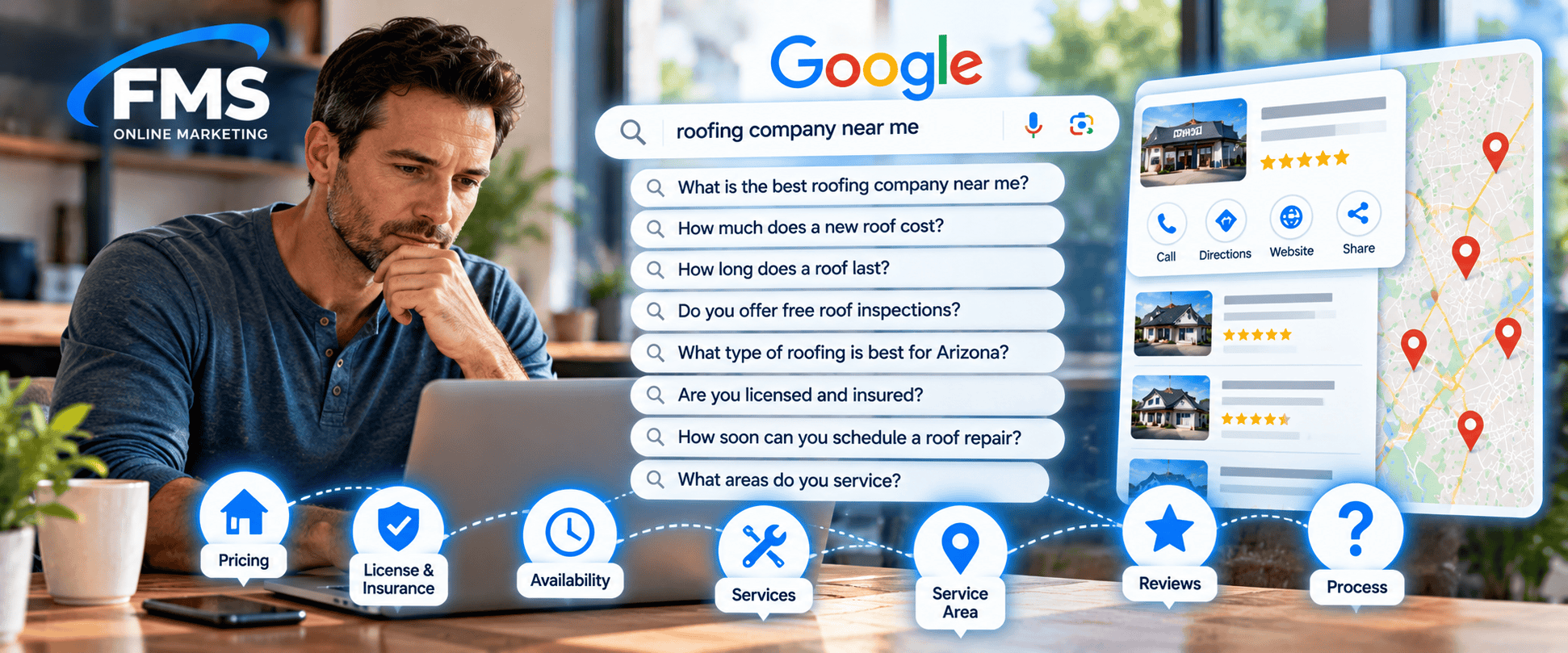
Every day, potential customers turn to Google with questions about the services your business provides.
They want to know what a repair might cost, how long the work could take, whether a troubling symptom requires immediate attention, and which local company can be trusted to handle it properly. They are weighing alternatives, watching for red flags, and trying to avoid a costly misstep.
Here is the question every business owner should consider:
Does your website give these people the answers they are looking for?
If it does not, they will keep searching. And the next website they visit may belong to your competitor.
Customers Usually Search for a Problem Before They Search for a Company
Most people do not begin their research by typing a particular company name into Google. Unless they already have a referral or know a business by reputation, they usually start with a problem.
Their searches might look like this:
- Why is my air conditioner running but not cooling the house?
- How much does a roof replacement cost in Phoenix?
- Can a damaged transmission be repaired instead of replaced?
- Will homeowners insurance pay for collision repairs?
- How long does artificial turf last in Arizona?
- Is low water pressure serious enough to call a plumber?
At first glance, these may appear to be simple informational searches. Look closer, though, and many of them reveal genuine buying intent.
Someone researching roof replacement costs may be getting ready to request estimates. A driver looking up the symptoms of transmission failure could need a repair shop within days—or even hours. A Phoenix homeowner whose air conditioner is blowing warm air during August is not casually browsing. That person needs help.
These questions are not peripheral to the customer journey. They are often where the journey begins.
Your website should be present at that moment.
What Is Google’s “People Also Ask” Section?
During a Google search, you may encounter a box labeled “People also ask.” It contains related questions that users can expand to view brief answers.
This section offers a revealing glimpse into the concerns surrounding a particular topic.
For instance, a person searching for “transmission repair in Phoenix” might also see:
- What are the earliest signs of transmission failure?
- Is repairing a transmission worth the expense?
- How long does transmission repair usually take?
- Can I drive a vehicle with a slipping transmission?
The exact questions can shift based on the search phrase, location, wording, and other contextual signals. Even with that variation, noticeable patterns tend to emerge.
Those patterns matter.
They reveal what potential customers are worried about, what they do not understand, and what may be preventing them from contacting a business. For a local company, that is valuable intelligence hiding in plain sight.
Why Customer Questions Deserve Your Attention
Every relevant question creates an opening for your business.
When your website offers a candid, useful answer, you introduce your company before the visitor is ready to call. You help that person make sense of the problem while quietly demonstrating that your team knows how to handle it.
Trust begins to form before a conversation ever takes place.
Not every visitor will call during the first visit. Some will read an article, examine several businesses, comb through reviews, discuss the decision with a spouse, and return a few days later.
That is normal.
If your website helped them understand the situation, your company has a better chance of remaining memorable when the time comes to act.
Answering the right questions can contribute to:
- Greater organic search visibility
- More pertinent website traffic
- Stronger authority in your local market
- Longer, more purposeful website visits
- Additional exposure in Google and AI-powered search results
- More qualified calls and form submissions
- Increased confidence before the first appointment
- Fewer repetitive questions during the sales process
The objective is not to attract every person who uses Google. It is to reach the people whose questions indicate a legitimate need for your services.
Does Your Website Address What Customers Truly Want to Know?
Many local business websites cover little more than the essentials.
They provide a list of services, a few photographs, a modest “About Us” paragraph, and some contact information. Those elements are necessary, but they may not be persuasive enough to help someone make a decision.
Prospective customers tend to have more pointed questions:
- How can I tell whether I genuinely need this service?
- What could happen if I postpone the repair?
- What should I reasonably expect to spend?
- How long will the work take?
- Is this covered by insurance?
- What is included in the service?
- Why should I choose one company over another?
- Can the problem be repaired, or will everything need to be replaced?
- Does the company serve my neighborhood?
- What should I do before the appointment?
- Is there anything I should avoid doing in the meantime?
If visitors cannot find those answers, they are likely to resume their search.
Once they leave, you cannot assume they will return.
A polished website may create a favorable first impression. A helpful website gives people a reason to stay.
A Service Page Should Do More Than Define the Service
A service page should never read like a dry encyclopedia entry.
Someone visiting a plumbing page does not need an elaborate definition of plumbing. The visitor wants to know whether your company can resolve a leaking pipe, stubborn clog, failing water heater, or mysterious drop in water pressure.
The distinction is significant.
A worthwhile service page should explain:
- Which problems the service can resolve
- What symptoms or warning signs customers should notice
- What the inspection or repair process involves
- Why delaying the work could make the situation worse
- Which circumstances influence cost
- How long the service may take
- Which communities the company serves
- Why the business is qualified to perform the work
- What the customer should do next
That final point is frequently overlooked.
Should the visitor call for an appointment? Request an estimate? Schedule an inspection? Upload photographs? Do not bury the next step beneath dense paragraphs or place the only call-to-action at the bottom of a lengthy page.
Effective content answers enough questions to reduce uncertainty without smothering the reader in needless detail.
FAQs Work Best When the Questions Are Real
A frequently asked questions section can strengthen a service page, location page, or blog article. It can also become meaningless filler.
The difference lies in the questions selected.
Too many FAQ sections are assembled as an afterthought. They feature bland questions that few customers ask, followed by thin answers that offer little substance.
A stronger FAQ section draws from genuine conversations and observable search behavior.
Useful questions may come from:
- Google’s “People Also Ask” results
- Google Search Console queries
- Customer telephone calls
- Sales consultations
- Website contact forms
- Online reviews
- Google Business Profile activity
- Social media conversations
- Estimates and in-person appointments
- Technicians, estimators, receptionists, and sales representatives
- Questions customers ask after receiving a proposal
Your own staff may be your richest source of content ideas.
If the front office answers the same question several times each week, that subject belongs on your website. If technicians repeatedly correct the same misconception, it should probably become an article or FAQ. If an objection continually stalls estimates, the issue deserves a thoughtful explanation.
Repeated questions are evidence. Pay attention to them.
Some of the Best Content Ideas Never Appear in a Keyword Tool
Keyword research remains useful, but it should not have complete dominion over your content strategy.
The most worthwhile topics often arise during ordinary customer conversations.
Think back to your last five sales calls or estimates.
What made those people uneasy?
Which part of the service confused them?
What nearly caused them to hesitate, delay, or choose another company?
An HVAC customer may be uncertain whether an aging system should be repaired or replaced. Someone dealing with collision damage may not understand the insurance claim process. A roofing customer could be apprehensive about deductibles, material choices, project timelines, or what happens if hidden damage is discovered.
These are more than customer-service questions. They expose the friction within the buying process.
Addressing that friction through your website creates content grounded in real customer demand rather than conjecture.
One Strong Question Can Fuel an Entire Content Campaign
A meaningful customer question should not always be confined to a single FAQ.
Suppose an HVAC company repeatedly hears:
“Why is my air conditioner running but not cooling my house?”
That one question could inspire:
- A succinct answer on the air-conditioning repair page
- A detailed troubleshooting article
- An FAQ on the homepage
- A Google Business Profile post
- A short educational video
- A seasonal email to existing customers
- A downloadable cooling-system checklist
- A social media post timed for the first major heat wave
This does not mean duplicating the same passage across every platform. It means adapting the answer to suit the customer’s location and stage of research.
A visitor reading the service page may need a prompt, direct explanation. Someone opening a troubleshooting guide may want greater depth. A social media follower may only need a short warning about when to turn off the system and call a professional.
The underlying question remains the same. The delivery changes.
This is how a cohesive content strategy develops—one anchored in actual customer needs instead of an assortment of disconnected blog topics.
Give the Answer Before Delivering the Sales Pitch
One of the most conspicuous mistakes in business content is avoiding the question in favor of self-promotion.
If someone asks how long a transmission repair takes, answer that question first. Do not make the reader wade through three paragraphs about your unwavering commitment to exceptional customer service.
Explain that the time-frame depends on the diagnosis, vehicle, availability of parts, severity of the damage, and whether the transmission needs to be removed. Then describe your process and invite the customer to arrange an inspection.
Helpful first. Promotional second.
People notice when a business sidesteps a straightforward question. They also appreciate honesty, even when the honest answer is, “It depends.”
Not every cost or timeline can be guaranteed before an inspection. That is perfectly reasonable. Explain why it varies, identify the deciding factors, and tell the visitor how your company arrives at an accurate answer.
Candor builds more confidence than a vague promise.
What If Your Company Does Not Publish Prices?
Many service businesses are reluctant to discuss prices on their websites. In industries where every project has different requirements, that reluctance makes sense.
You do not need to publish rigid pricing to answer a cost question well.
What you should avoid is pretending the question does not exist.
Instead of announcing a fixed amount, explain the variables that influence the final cost. Depending on the service, those may include:
- The size and intricacy of the project
- Materials or replacement parts
- Labor requirements
- Accessibility of the damaged area
- Age and condition of the existing equipment
- Insurance involvement
- Emergency or after-hours service
- Local permit requirements
- Previously attempted repairs
- Additional damage uncovered during the inspection
This approach offers practical guidance without committing your company to an estimate before the facts are known.
It also helps discourage poor-fit inquiries. Customers begin to understand why two seemingly similar jobs may carry very different prices.
Can Google and AI Platforms Understand Your Answers?
Website content should always serve the reader first. Still, clear organization helps search engines and AI platforms interpret that information accurately.
A page becomes easier to understand when it has one discernible purpose and follows a sensible structure.
Useful elements include:
- A clear and specific page title
- Descriptive headings
- Focused paragraphs
- Direct answers placed near the beginning of each section
- Natural, conversational wording
- Relevant links to related pages
- Accurate service and location information
- Substantial FAQ answers
- Examples drawn from genuine experience
- Current and consistent business details
Keyword repetition is not a substitute for clarity.
Wedging the same search phrase into every other paragraph makes a page cumbersome and unpleasant to read. It does not make the answer more credible, nor does it make the company appear more knowledgeable.
The strongest content resembles a conversation with an experienced professional—someone who understands the issue, speaks plainly, and does not waste the customer’s time.
“People Also Ask” Research Is a Starting Point, Not a Strategy
Google’s related questions can uncover excellent content opportunities. Simply copying dozens of those questions into an FAQ section, however, is not a sound strategy.
Each question should earn its place.
Before adding one to your website, consider:
- Is the question closely related to a service we offer?
- Does it reflect a genuine customer concern?
- Is the person asking it likely to need our help?
- Can our professional experience add something useful to the answer?
- Does another page on the website already address it?
- Should the answer appear on a service page, location page, blog article, or FAQ?
- Does the topic require a brief answer or a more thorough explanation?
- What should the reader do after receiving the answer?
Relevance matters more than volume.
Ten carefully chosen questions with substantive answers can be far more valuable than 100 generic entries published merely to inflate the page.
How to Uncover the Missing Answers on Your Website
Begin with one of your most important services.
questions customers ask using the kind of wording a customer would naturally use. Review the related questions, suggested searches, local results, and competing pages.
Then examine your own website through the eyes of someone who knows nothing about your company.
Can that person quickly find information about:
- Common symptoms and warning signs?
- Possible solutions?
- Factors affecting cost?
- Typical service timelines?
- Your inspection or repair process?
- Your company’s experience and qualifications?
- Neighborhoods and cities served?
- Warranties or guarantees?
- Financing, insurance, or payment options when applicable?
- What happens after an appointment is requested?
- The clearest next step?
Write down every question that is missing, buried, or answered poorly.
Not every content gap requires a brand-new page. Some may call for a comprehensive article. Others can be remedied with a sharper introduction, a more detailed FAQ, a short section on an existing service page, or a clearer call-to-action.
The solution should fit the question.

Customer Questions Can Become Qualified Leads
Question-based content should accomplish more than generating an impressive traffic report.
Website visits have limited value if they never contribute to the business.
Your content should help prospective customers:
- Identify the problem they may be experiencing.
- Understand the remedies available.
- Recognize the consequences of postponing action.
- Develop confidence in your company’s expertise.
- Take a sensible next step.
That next step might be a telephone call, estimate request, inspection, consultation, or completed contact form.
When a website answers customer questions well, the sales process starts quietly in the background. The visitor learns how the problem works, what choices are available, and why the company may be the right one to call.
By the time direct contact occurs, the customer is no longer starting from zero.
Is Your Website Giving Customers the Answers They Need?
Potential customers are searching for answers right now.
Some are exploring an early concern. Others are comparing local companies. A portion of them are ready to schedule service today.
If your website provides lucid, credible answers, your business has an opportunity to earn their attention—and eventually their trust. If the information is absent, a competitor may become the source they rely upon.
FMS Online Marketing helps local businesses uncover the questions their customers are actually asking and identify where their current website falls short.
We examine relevant searches, Google’s “People Also Ask” results, customer search behavior, and existing service-page content. The purpose is not to manufacture unnecessary pages. It is to reveal worthwhile opportunities where better answers could strengthen visibility, clarify your expertise, and generate more qualified leads.
Find Out What Your Website Is Missing
Request a Customer Question & Website Content Audit from FMS Online Marketing.
We will identify pertinent questions your prospective customers are asking, evaluate whether your website answers them adequately, and uncover content gaps that may be costing your business attention, trust, and inquiries.
Your customers already have questions.
Let’s make sure your website has answers worth finding.