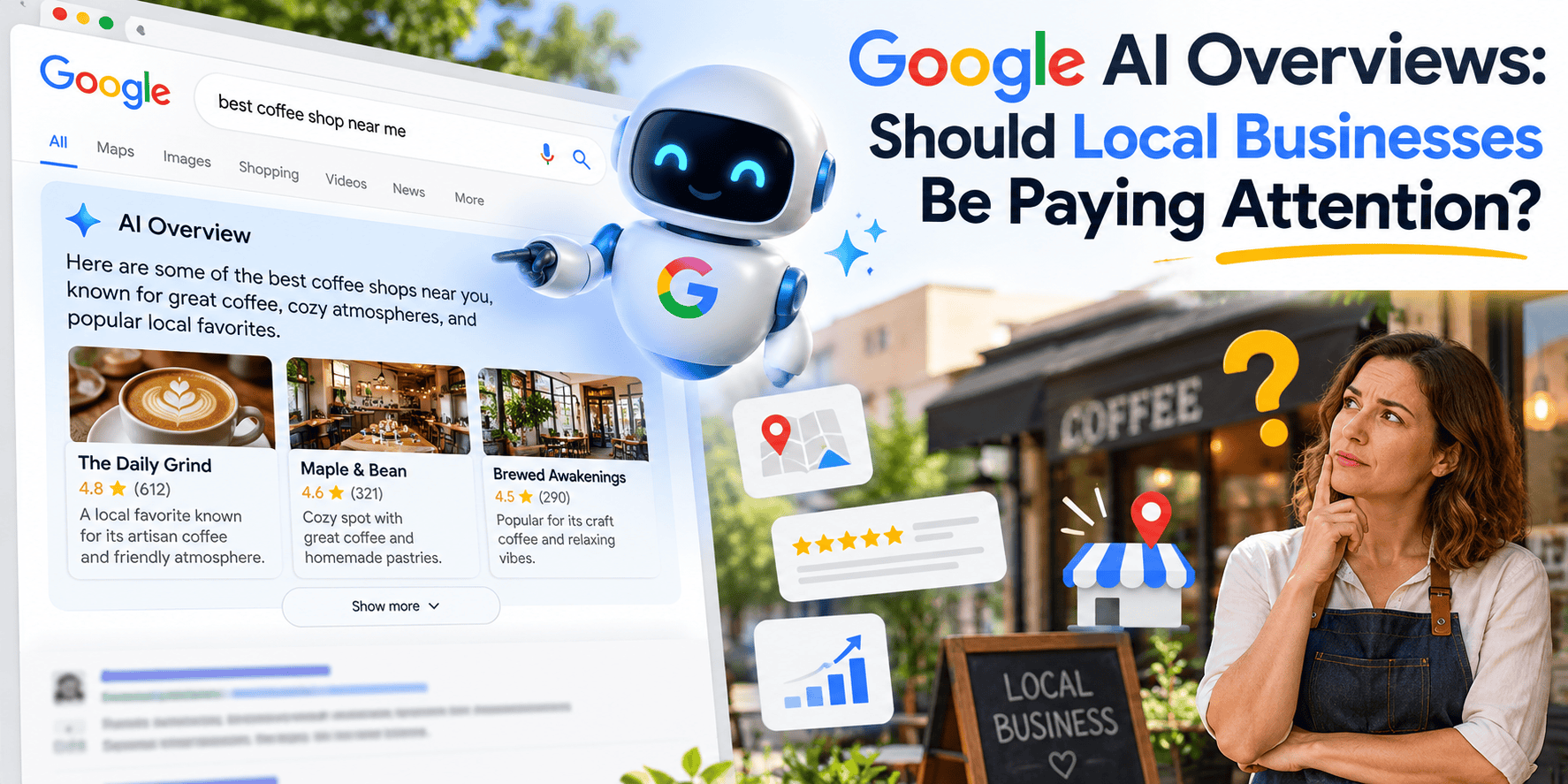
Google AI Overviews are AI-generated summaries that can appear above traditional search results for some queries, with supporting links to cited pages. Local businesses should not treat them as a separate ranking system. According to Google Search Central, existing SEO fundamentals remain relevant, no special AI schema is required, and pages already eligible for normal search snippets may also be eligible as supporting links in AI Overviews.
Picture a homeowner who searches for an emergency HVAC repair near Phoenix on a Tuesday afternoon. Before they scroll to the Local Pack or click an organic listing, a synthesized answer block appears with key information and a handful of supporting links. That moment, repeated thousands of times a day across different queries and industries, is why local businesses are asking whether their online presence is keeping up.
The honest tension here is real: business owners want to know whether AI Overviews change the value of local SEO or simply change how visibility is displayed. The answer matters because the wrong response, either ignoring the shift entirely or buying into unproven AI inclusion promises, can cost time, money, and market position.
This guide separates confirmed Google guidance from industry speculation and turns the topic into practical local search actions. As the owner of FMS Online Marketing, I want to be upfront: FMS has a commercial interest in local SEO services, so use the framework below to evaluate any provider, including FMS.
What Are Google AI Overviews?
Google AI Overviews are AI-generated summaries that appear within Google Search results for certain queries. They synthesize information from multiple indexed sources and display supporting links alongside the AI-generated answer. The feature is distinct from traditional blue-link results, featured snippets, the Local Pack, Google Maps, and Google Business Profile listings.
According to Google Search Central, pages that are already indexed and eligible for normal search snippets may be eligible to appear as supporting links in AI Overviews. Eligibility is not the same as guaranteed inclusion. Google does not provide a request-for-inclusion process, and the feature does not appear for every query.

AI Overviews, organic results, and local results can coexist on the same page. The layout, order, and presence of each feature varies by query, device, user context, and location, so no single configuration should be assumed as the default.

How AI Overviews differ from organic listings and featured snippets
The table below maps the key differences across the search features that matter most to local businesses.
| Feature | Format | Source behavior | User action | Visibility implication |
|---|---|---|---|---|
| Google AI Overviews | AI-synthesized answer block with supporting links | Synthesizes content from multiple indexed sources | May read the answer and click a supporting link, or take a direct action | Eligible pages may appear as supporting links; no guaranteed placement |
| Organic listings | Individual blue-link results with title and description | Surfaces a single indexed page | Clicks through to the website | Position-based; eligibility tied to indexing and relevance |
| Featured snippets | Pulled excerpt from a single page with a link | Surfaces structured or direct-answer content | Reads the excerpt or clicks through | Single source; position zero placement, not guaranteed |
| Local Pack | Map-based 3-listing display | Pulls from Google Business Profile and local signals | Calls, gets directions, visits the profile | Tied to relevance, distance, and prominence; separate from organic |
| Google Maps | Full map and listing experience | Google Business Profile data plus third-party sources | Directions, calls, profile visits | Requires an accurate, verified Business Profile |
Do Google AI Overviews replace the Local Pack?
No. AI Overviews, organic results, and local results can appear together on the same results page, and each serves a different searcher intent. The presence or absence of any feature depends on the specific query, the device, and the user’s location. For high-intent local queries such as “plumber near me” or “dentist accepting new patients,” the Local Pack and Google Maps often remain the most prominent local discovery surfaces. AI Overviews are not a replacement for Maps optimization or a Google Business Profile.
Why Should Local Businesses Pay Attention to Google AI Overviews?
When Google answers part of a customer’s question before they click anything, the discovery journey changes. A searcher looking for a roofing contractor in the Phoenix metro area may read a synthesized answer, scan the supporting links, and then decide whether to visit a website, call from a profile, or request directions, all without following the traditional path from organic result to website.
This matters for local businesses because the actions customers take, calls, direction requests, appointment bookings, form submissions, and branded searches, are influenced by what appears above and alongside traditional results. Google Search Central confirms that indexed pages with useful, clear content may appear as supporting links in AI Overviews, which makes the quality and clarity of your online presence more consequential, not less.
What changes when Google answers part of the question before the click?
The searcher still acts. A cited link in an AI Overview can drive a direct visit. A map listing below an AI Overview still captures direction requests and calls. A well-optimized Google Business Profile still influences whether a business appears in the Local Pack alongside or below an AI-generated answer. The key shift is that businesses with vague, incomplete, or inconsistent information are less likely to be understood clearly, whether by a human reading a search result or by a system synthesizing one.
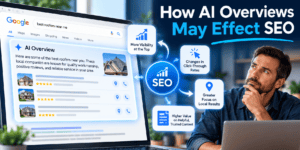
How AI Overviews May Affect Local SEO
Google’s official guidance on local ranking centers on three factors: relevance, distance, and prominence. According to Google Business Profile Help, these factors determine how local results are ranked, and they remain the foundation of local visibility whether or not AI Overviews appear on a given page.
Relevance, distance, and prominence still matter
Relevance refers to how well a business listing and website match what a searcher is looking for. Complete business information, accurate service descriptions, and clear location details help Google understand what you offer and who you serve.
Distance measures how far each potential search result is from the location term used in the query or from the searcher’s actual location. Businesses cannot control their physical location, but accurate address information, service-area settings, and verified Business Profiles ensure that Google has the correct data.
Prominence reflects how well-known a business is based on information gathered from across the web: links, articles, third-party directories, reviews, and other signals. A strong review profile, consistent business citations, and authoritative content all contribute to prominence over time.
No agency or tool has access to a confirmed formula for how each factor is weighted. The practical instruction is to make your business information as complete, accurate, and well-supported as possible.
Why entity consistency matters across your website and profiles
When the business name, address, phone number, service categories, service areas, and hours match consistently across your website, Google Business Profile, and third-party directories, Google can more confidently understand and represent your business. Inconsistencies, such as different phone numbers on the website and the profile, or service descriptions that contradict each other, create ambiguity that can reduce confidence in your information across all surfaces, including AI-generated answers.
Which Local Businesses Should Pay the Closest Attention?
Not every business will see AI Overviews appear for their most important queries today. However, service businesses that depend on local discovery, customer trust, and defined service areas have a practical reason to improve information clarity now, because the signals that support AI search visibility are the same ones that support Maps rankings, Business Profile performance, and organic local results.
High-intent service businesses
HVAC companies, plumbers, roofers, general contractors, auto repair shops, law firms, medical practices, and dental practices share a common trait: customers search with high intent and an urgent need. A query like “emergency AC repair near me” or “dentist accepting new patients in the Phoenix area” carries an immediate action signal. Businesses in these categories that have clear, accurate, and trust-supported information across their profile and website are better positioned for discovery, whether through AI Overviews, the Local Pack, or direct Maps searches. FMS Online Marketing specifically serves several of these industries, including automotive, HVAC, legal, medical, plumbing, and roofing.
Multi-location and service-area businesses
Franchises and service-area businesses face an added layer of complexity. Each location or coverage area needs accurate Business Profile eligibility, distinct service information, and location-specific content that answers real customer questions. Building useful service-area pages with original local proof, customer-relevant answers, and a clear next step is more effective than swapping city names into duplicate templates.
What Should a Local Business Do About Google AI Overviews Today?
Google states clearly that no special AI optimization or additional technical requirements are needed for a page to be eligible as a supporting link in AI Overviews. The practical action plan follows the same priority order as sound local SEO.

Improve your Google Business Profile foundation
Start here because incomplete or inaccurate profile information creates problems across every search surface, not just AI Overviews. According to Google Business Profile Help guidelines, businesses should:
- Verify the profile is claimed and correctly verified
- Confirm that the business name, address, phone number, and website match what appears on the website and other directories
- Select accurate primary and secondary categories
- List all services with descriptions
- Set correct business hours, including holiday hours
- Upload recent, relevant photos
- Configure service-area settings accurately for businesses that serve customers at their locations
- Actively request reviews from satisfied customers in a manner consistent with Google’s review guidelines
For managed Google Business Profile and Google Maps services, Google Business Profile and Google Maps services from FMS cover these foundations as part of a local SEO engagement.
Build clear service and location content
Service pages and location pages should each answer a distinct customer intent. A page about roofing repair in Glendale should explain the service, describe the service area, address common customer questions specific to that area (such as storm damage or monsoon-season roof repairs), and include a clear next step. Vague statements like “we serve the greater Phoenix area” tell neither the customer nor Google anything specific.
Use structured data without chasing an AI shortcut
Google says no special AI schema is required for AI Overview eligibility. Structured data, including LocalBusiness schema, should accurately describe what is visible on the page and support normal search understanding. If a business page lists its hours, address, and services visibly on the page, structured data marking up those details is appropriate. Implementing schema that does not match visible content, or adding FAQ schema to questions that do not appear on the page, can create inconsistencies that undermine trust.
Do Google Business Profile and Google Maps Still Matter for AI Search?
Yes. Google Business Profile and Google Maps remain important parts of local search visibility. Google’s official local ranking guidance continues to emphasize complete and accurate business information as a factor in how local results appear, and that guidance has not changed with the introduction of AI Overviews.
The information Google uses to understand a local business
According to Google Business Profile Help, Google draws on a range of sources to understand and represent a business: the official website, Business Profile information, publicly available information, third-party data sources, user contributions, photos, and reviews. Google Business Profile is one important source, not the only one. This means that inconsistencies across your website, profile, and external directories can create gaps in what Google understands about your business, regardless of how well any single source is optimized.
For a broader explanation of how AI search works in a local business context, see this AI search explained for business owners resource from FMS.
What Content Helps AI Systems Understand a Local Business?
AI systems, like traditional search algorithms, need clear signals about what a business does, where it operates, who it serves, and why it is trustworthy. People-first content, written to genuinely answer customer questions, also happens to be the kind of content that is most useful for AI systems trying to synthesize an accurate answer.
Answer customer questions in plain language
Practical examples of questions that service pages and FAQs should address:
- “How much does an AC tune-up cost in the Phoenix area?”
- “Do you serve [specific city or zip code]?”
- “What should I expect during a roof inspection?”
- “How quickly can a plumber arrive for an emergency?”
- “Is your practice accepting new patients?”
- “What insurance do you accept?”
Each answer should be direct, accurate, and specific to the actual business. Generic placeholder answers that apply to any business in any city do not serve the reader or the system trying to understand the page.
Show expertise without inventing experience
I recommend grounding content in the genuine expertise of the people behind the business. For an auto repair shop, that means explaining why a specific service matters, what the process looks like, and what a customer should bring or know before arriving. This kind of content demonstrates subject-matter understanding without requiring fabricated case studies or invented statistics. Use real credentials, real service details, and real local knowledge.
How Can a Local Business Measure AI Search Visibility?
Google launched dedicated Search Generative AI performance reports in Google Search Console on June 3, 2026, and confirmed that the rollout reached all websites worldwide as of August 31, 2026, per Google Search Central Blog. The reports appear as an expandable tab under the main Performance report and show impressions from AI Overviews, AI Mode, and generative AI features in Discover.

Use Google Search Console’s generative AI reporting where available
The generative AI performance report shows impressions by page, country, device, and date range. It does not currently include click data or query-level detail. If a property does not show the report, Google states this may be because the site has not received enough AI impressions yet. Before drawing conclusions from the data, verify that your Search Console property is correctly configured and that the data covers a meaningful time period.
I also recommend using controlled query checks to observe AI Overview presence: search your core service-and-location queries on a clean browser session, record the date, device, and query, and document whether an AI Overview appears and whether your business or website is cited. Repeat this at regular intervals to build a picture of trend rather than a one-time snapshot.
Connect visibility metrics to customer actions
| Metric | Source | What it tells you | Limitation |
|---|---|---|---|
| AI impressions | Google Search Console generative AI report | How often your pages appear in AI features | No click data; does not confirm a lead was generated |
| Organic clicks and impressions | Google Search Console performance report | Overall search visibility and CTR | Does not separate AI-driven clicks from standard organic |
| Profile interactions | Google Business Profile Insights | Calls, direction requests, website visits, messages from the profile | Does not capture assisted conversions or offline actions |
| Branded query volume | Google Search Console | Whether AI citation may be increasing brand awareness | Correlation only; many factors influence branded search |
| Calls and form submissions | Call tracking software, CRM, analytics | Direct customer actions | Requires conversion tracking to be set up correctly |
| Qualified leads | CRM or sales records | Revenue-relevant outcomes | Requires lead qualification process; not automatic |
Impressions and AI citations are useful signals, but they are not revenue. A business that appears in AI Overviews and has no call tracking, no conversion goal setup, and no lead qualification process cannot measure whether visibility is translating into customers. Use your local SEO audit checklist to verify that measurement is in place before drawing performance conclusions.
Should You Change Your Local SEO Strategy Today?
The one-sentence answer: strengthen established local SEO fundamentals and build answer-focused content rather than chasing unproven AI inclusion promises.
Google has not introduced a separate AI optimization track. The businesses that are best positioned for AI search visibility are the same ones that rank well in local organic results and the Local Pack: they have accurate profiles, useful content, consistent business information, strong reputation signals, and technically accessible websites.
If you want a work-planning sequence rather than a guaranteed results timeline, consider this framework:
- First 30 days: Audit and correct the Google Business Profile. Fix NAP (name, address, phone) consistency across key directories. Verify the website is crawlable, indexed, and mobile-friendly. Document your current baseline metrics in Search Console and Business Profile Insights.
- Next 30 days (days 31 to 60): Improve or add service pages and location pages with direct answers, local context, and clear next steps. Review your FAQ coverage and add genuinely useful questions. Begin or improve your review request process.
- Days 61 to 90: Review measurement data. Assess whether AI impressions, profile interactions, and qualified leads are trending in the right direction. Adjust content and profile details based on what the data shows.
This is a planning structure, not a performance promise. Timing depends on market competition, the current state of your digital presence, content quality, and consistent execution.
When an AI-search-focused service may not be the right fit
Businesses that need guaranteed rankings, immediate results, or specific promises about appearing in AI Overviews will find that no credible agency can honestly deliver those commitments. If your primary channel is paid advertising and organic local SEO is a secondary concern, the foundation work described above still has value, but the expected return timeline and approach will differ. Local SEO services are most effective when the business is committed to the ongoing work of maintaining accurate information and improving content quality.
Frequently Asked Questions About Google AI Overviews for Local Businesses
Can a local business request inclusion in a Google AI Overview?
No request-for-inclusion process exists. According to Google Search Central, pages that are indexed and eligible for normal search snippets may be eligible as supporting links. The path to eligibility is accurate, crawlable, useful content, not a submission form.
Do Google AI Overviews replace Google Maps?
No. They are different search experiences that can appear together or separately depending on the query. Google Maps and the Local Pack serve local discovery intent and remain important for businesses that depend on direction requests, calls, and profile visits.
Do reviews influence local visibility?
Yes, as a component of prominence. Google’s local ranking guidance states that reviews contribute to how Google understands a business’s reputation. No specific review count or rating is confirmed to guarantee any ranking outcome.
Does structured data guarantee AI Overview visibility?
No. Google states explicitly that no special AI schema is required for AI Overview eligibility. Structured data should match visible page content and support normal search understanding, not serve as an AI shortcut.
How long does it take to improve local search visibility?
There is no fixed timeline. Timing depends on the current state of your Business Profile and website, market competition, the quality of your content, and how consistently improvements are implemented. Treat planning sequences as checkpoints, not promises.
Should a small business optimize for AEO or GEO separately from SEO?
Not as a separate system. Answer engine optimization (AEO) and generative engine optimization (GEO) are useful frameworks for thinking about answer-focused content, but the practical work, clear service descriptions, accurate business information, direct answers to customer questions, and strong local signals, overlaps substantially with sound local SEO. Treating them as distinct paid services with separate deliverables is not supported by current official guidance.
How can I track whether my business appears in AI search?
Use Google Search Console’s generative AI performance report, which shows impressions from AI Overviews and AI Mode by page, device, country, and date. Supplement with controlled query checks: search your core service-and-location queries on a clean browser session and document what appears. Record the date, query, and device each time.
What should I fix first if my business is missing from local search?
Start with Business Profile eligibility and verification, then address NAP consistency across directories, website indexability, and service and location page clarity. A strong review profile and accurate conversion tracking should follow. Use your local SEO audit checklist as a diagnostic starting point.
Does Google Business Profile affect AI search visibility?
Yes, indirectly. Google uses Business Profile information as one of multiple sources to understand and represent a local business. An incomplete or inaccurate profile creates gaps in what Google can confidently surface, across organic results, the Local Pack, and AI features.
Is an AI search optimization service necessary for every small business?
Not as a standalone purchase. The improvements that support AI search visibility are the same ones that support local SEO broadly: accurate profiles, clear content, strong reputation signals, and technical accessibility. A business that has not yet built a solid local SEO foundation will benefit more from fixing fundamentals than from buying a specialized AI optimization add-on.
What Is the Best Next Step for a Local Business?
The central answer to this article’s question is straightforward: yes, local businesses should pay attention to Google AI Overviews, but the response should be to strengthen existing local SEO fundamentals, not to chase a shortcut that does not exist.

Before deciding whether you need outside help, work through this checklist:
- Is the Google Business Profile accurate, verified, and fully populated with services, hours, photos, and a correct service area?
- Does the website clearly explain what you do, where you do it, and how a customer can take the next step?
- Are business information details consistent across the website, Business Profile, and key directories?
- Do you have a process for requesting and responding to customer reviews?
- Can you currently measure calls, form submissions, direction requests, and qualified leads?
If you answered no to several of these, the foundation work is the priority. If the foundation is in place and you want help improving content quality, measuring AI search visibility, or building a more complete local presence, request a local SEO strategy discussion with FMS Online Marketing to review your current situation without a ranking promise attached.