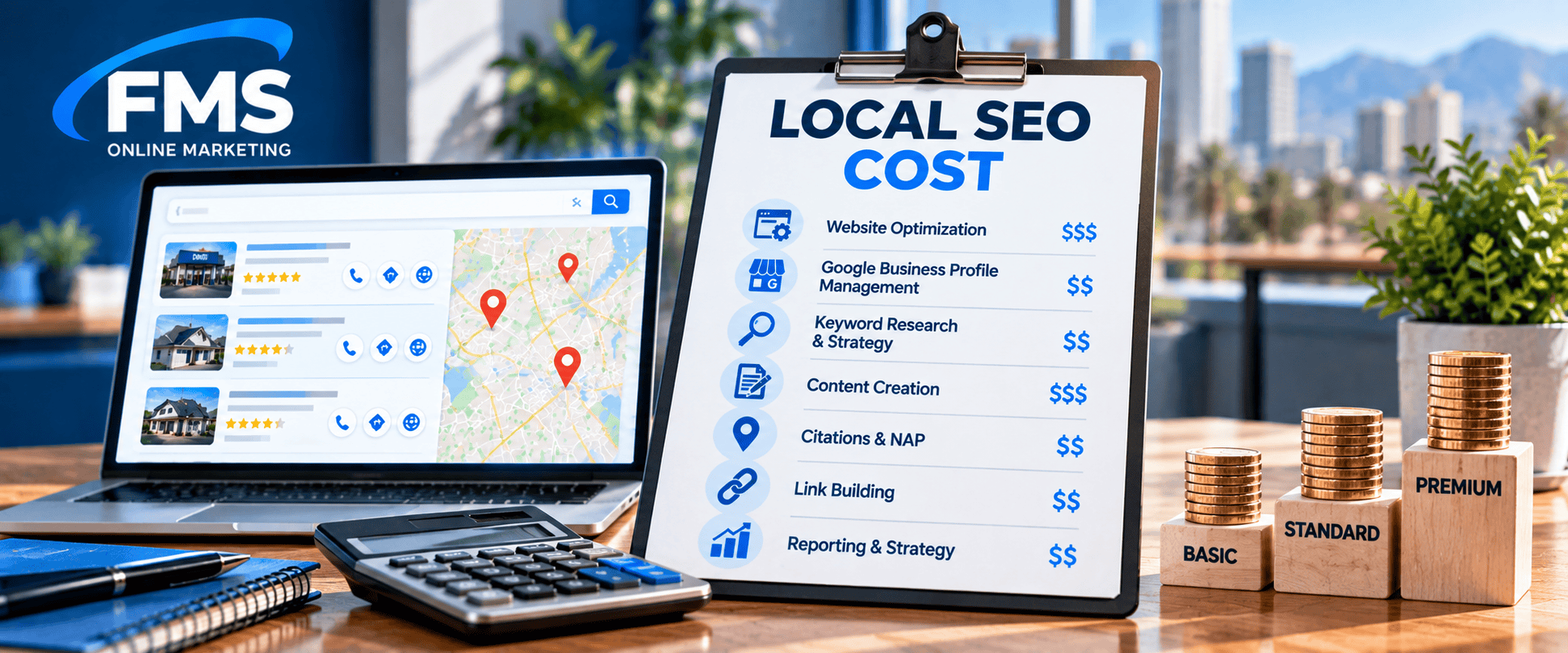
Local SEO in the United States can cost from a few hundred dollars per month for limited foundational work to several thousand dollars for ongoing strategy, competitive markets, or multiple locations. Published 2026 guides from sources including SEO.com and WebFX commonly place agency retainers in a broad range of roughly $500 to $3,000 per month for single-location small businesses, with complex or multi-location programs running higher. Treat those figures as directional market context. They reflect what agencies publicly quote, not a guaranteed outcome or the pricing of any specific provider.
You have two quotes on your desk. Both say “GBP optimization,” “localized content,” and “monthly reporting.” One is $600 a month. The other is $2,200. The service labels look almost identical.
That gap is not unusual, and it is not random. Local SEO quotes vary because the scope behind the label varies enormously. A $600 retainer might mean one round of profile edits and a PDF report. A $2,200 retainer might mean ongoing content creation, citation management, review strategy, technical fixes, and weekly Google Business Profile activity across a competitive market.
This guide separates price from scope, location count, competition level, deliverables, and measurement. The goal is not to find the cheapest provider. It is to help you identify a budget and scope you can evaluate honestly before signing anything.
How much does local SEO cost in 2026?
Local SEO pricing in the United States spans a wide range because the underlying work varies by market, business size, location count, and competitive pressure. A business in a small market with one location and modest competition faces a different workload than a roofing company competing across a dense metro area with multiple service zones.
Directional US market ranges published in 2026 by sources including WebFX local SEO pricing and SEO.com’s local SEO pricing guide suggest that most small businesses receive quotes somewhere between $500 and $3,000 per month for agency retainers. One-time project work commonly falls between $500 and $5,000 depending on scope. Hourly consulting rates range from roughly $75 to $200 per hour or more.

These figures are directional ranges drawn from agency-published guides and provider surveys, not a controlled market census. Actual quotes depend on what the engagement includes.
Local SEO pricing at a glance
| Engagement model | Typical US range | What it usually covers | Notes |
|---|---|---|---|
| DIY local SEO software | $29 to $150/month (tool only) | Rank tracking, citation monitoring, GBP audits, basic reporting | Requires internal time and SEO knowledge. BrightLocal plans start at $39/month (verified July 2026 via SaaS Price Hub). |
| One-time project | $500 to $5,000 (one-time) | Audit, GBP setup, citation cleanup, technical fix, location page build | Not a substitute for ongoing work. Scope determines price. |
| Monthly retainer, starter | $500 to $1,200/month | GBP maintenance, basic citation work, limited reporting | Suits single-location businesses in lower-competition markets. |
| Monthly retainer, growth | $1,200 to $2,500/month | GBP management, content, citation building, review strategy, reporting | Better fit for competitive industries or active growth programs. |
| Monthly retainer, competitive | $2,500 to $5,000+/month | Full-scope ongoing strategy, local link building, content, technical SEO, detailed attribution | Appropriate for dense markets, high-value industries, or multi-location businesses. |
| Hourly consulting | $75 to $200+/hour | Strategy, audits, guidance, training | Useful for project-specific needs or supplementing in-house teams. |
| Multi-location program | Varies; often priced by location or scope | Separate profiles, citations, pages, review workflows, reporting per location | Price scales with footprint and deliverable count. |

Ranges are directional US market context compiled from 2026 published sources including WebFX, SEO.com, and Arc4. They are not FMS Online Marketing pricing or a guarantee of outcomes. Verify any specific quote against a written scope of work.
What do local SEO services include at each price point?
Two providers can charge the same monthly fee and deliver completely different amounts of work. Understanding what sits behind a price band is more useful than comparing headline numbers.

Starter-level work at the lower end of the market typically focuses on foundational tasks: setting up or correcting the Google Business Profile, performing a citation audit, fixing obvious NAP (name, address, phone) inconsistencies, and producing a basic monthly report. This is genuinely useful, but it is setup and maintenance work, not an ongoing growth program.
Growth-level and competitive programs add ongoing content production (service area pages, location pages, blog content with local intent), active review management, local link building, technical SEO improvements, Google Search Console monitoring, and attribution reporting tied to business outcomes like calls and form submissions.
Our local SEO services page describes the types of work that go into an ongoing local SEO program. The key point is that deliverables drive cost, and scope questions should come before price comparisons.
What should a starter local SEO package include?
A foundational package for a single-location business in a lower-competition market should include at minimum: a complete Google Business Profile audit and optimization, NAP consistency review across key directories, an initial citation audit, and a monthly performance report covering GBP actions such as calls, direction requests, and website clicks.
Setup-only work is not the same as ongoing growth work. A cleaned-up profile and corrected citations improve your starting position, but they do not replace the month-over-month content, review, and authority work that sustains and builds local search visibility over time.
Some providers charge a one-time setup fee on top of the monthly retainer. Ask whether the first invoice includes onboarding work that is separate from the recurring scope.
What should a growth or competitive package include?
A growth-oriented local SEO program adds consistent execution across several areas: regular localized content production tied to services and geography, an active review generation and response strategy, structured citation building and management, local link building with real outreach, technical SEO maintenance, and reporting connected to qualified leads rather than only rankings.
Google identifies relevance, distance, and prominence as the main factors in local search results. Prominence in particular reflects the depth of a business’s online presence, which is built over time through content, reviews, citations, and authority signals. That ongoing work is what separates a growth retainer from a one-time project.
As a practical note: a business in a competitive industry such as legal, medical, dental, HVAC, plumbing, roofing, or contracting typically needs more content depth and review volume to compete than a business in a lower-demand local category.
What factors raise or lower local SEO pricing?
Local SEO pricing is not a flat rate applied equally to every business. Several factors shift the workload, and with it, the cost.
Competition and market density have the largest effect. A plumber in a small Arizona town competes with a handful of businesses in the Local Pack. A plumber in the Phoenix metro area may face dozens of established competitors with strong review profiles, active citation networks, and ongoing content programs. More competition means more sustained effort.
Website condition matters more than most buyers expect. A site with technical issues, thin content, no location pages, and poor mobile performance requires remediation before local SEO can build on a stable foundation. That extra work adds to initial cost.
Google Business Profile condition is similar. A profile that has never been properly set up, has incorrect categories, missing service descriptions, no photos, or accumulated spam edits requires more initial effort.
Industry and customer value influence appropriate budget. High-value service industries where one new customer represents thousands of dollars in revenue can justify a larger monthly investment than businesses with small average transaction sizes.
Content and technical debt are often overlooked cost drivers. If the site has no service area pages, no location-specific content, and a slow mobile experience, those gaps need filling before the program gains traction.
How does the number of locations affect local SEO cost?
Each business location typically requires its own Google Business Profile, citation record, location page, review workflow, and reporting segment. That means each additional location adds real labor to the program.
A business with three locations does not simply pay three times the cost of a single-location program, because some strategy and reporting work overlaps. But the per-location work for profiles, citations, local pages, and review monitoring does scale with footprint. Multi-location businesses and franchises should expect that scope, and therefore cost, increases meaningfully with each active location.
When evaluating a multi-location quote, ask the provider to itemize what is done per location versus what is shared across the program.
Which local SEO pricing model fits your business?
Choosing a pricing model is a decision about who does the work, how predictable the cost is, and how much strategic depth the engagement provides.
| Model | Control | Predictable cost | Strategy depth | Hidden cost to watch |
|---|---|---|---|---|
| Monthly retainer (agency) | Shared | Yes | High | Minimum term, setup fees, cancellation terms |
| One-time project | High | Yes (fixed scope) | Moderate | Ongoing gaps after project ends |
| Hourly consulting | High | Low | Varies | Adds up fast; requires internal execution |
| DIY software | Full | Yes (tool cost) | Low to moderate | Requires internal time, knowledge, and consistency |
| In-house SEO staff | Full | No (salary + tools) | High if experienced | Recruiting, onboarding, benefits, and retention |
A monthly retainer from an agency trades some control for consistency and execution capacity. Hourly consulting gives you specific guidance but leaves execution to your team. DIY software keeps cost low, but the real cost is the internal time and expertise required to act on the data.
I would suggest that small businesses without an internal marketing team with SEO experience get more consistent results from a managed retainer than from purchasing a software subscription they do not have time to use.
How should a small business set a local SEO budget in 2026?
Rather than picking a number from a pricing table, work through these five questions:
- How many locations need visibility? Each active location adds to the scope and cost. Start with your highest-priority market.
- What is a qualified lead worth to your business? If an average customer generates $2,000 in revenue and you close one in four qualified leads, each lead is worth $500. A monthly retainer at $1,000 needs to produce only two additional qualified leads per month to cover its cost.
- What deliverables do you actually need? A business with an already-clean profile, good reviews, and strong citation accuracy needs a different scope than one starting from scratch.
- What technical work is required first? If the site has fundamental issues, budget for a one-time fix or audit before committing to a growth retainer. Some providers include this in onboarding; others charge separately.
- When will you review results? Set a 90-day checkpoint to compare baseline metrics with current performance. Avoid open-ended agreements with no defined review point.
The honest answer to “what is affordable” depends on your customer value and internal capacity, not only on what a pricing table says is normal for your industry.
How do you compare local SEO agency quotes?
When evaluating two quotes with similar labels, ask these questions before deciding:
- What is done each month, specifically? Ask for a list of deliverables, not a summary of categories.
- How many locations does the quote cover?
- Who does the work? In-house team, offshore contractors, or a mix?
- Who owns the Google Business Profile, website content, citations, and analytics access after cancellation? Google’s third-party management policies are clear that the business owner should retain control of their profile regardless of who manages it.
- What is the minimum term and cancellation process?
- Are setup fees separate from the monthly retainer?
- What does the monthly report include, and does it connect to business outcomes?
- What is explicitly excluded from the scope?
I would also look for red flags: vague language like “ongoing optimization” with no deliverable list, guarantees of specific ranking positions (which no legitimate provider can guarantee), reports that show only rankings and traffic with no connection to calls or leads, and ownership language that is unclear or absent.
Reviewing local SEO case studies from a provider before hiring can help you understand whether their documented work matches your expectations for transparency and depth.
Is local SEO worth the cost compared with Google Ads?
Neither channel is universally better. The comparison depends on your timeline, budget, and business goals.
| Factor | Local SEO | Google Ads |
|---|---|---|
| Time to visibility | 90 Days -Months of sustained work | Near-immediate after campaign launch |
| Cost structure | Monthly investment in an asset you build | Ongoing spend; visibility stops when spend stops |
| Intent targeting | Organic local intent, maps, and discovery | Keyword-matched paid placement |
| Compounding value | Authority and content can continue producing results | No residual value after spend ends |
| Control | Limited (algorithm-dependent placement) | High (budget, targeting, messaging, timing) |
| Best for | Long-term visibility and trust building | Fast lead generation, testing, and immediate coverage |

For many small businesses, the practical answer is that Google Ads can provide immediate visibility while an organic local SEO program is being built. The two channels are not mutually exclusive, and businesses that combine them often see better coverage across the search results page. The key distinction is that local SEO builds an asset over time, while paid search is a rental. Both require sustained investment to produce results.
What should you measure before renewing a local SEO service?
Rankings alone are not enough. Before renewing a contract, review these grouped metrics:
Visibility: GBP impressions, Google Maps views, Local Pack appearances, and organic keyword ranking trends.
Engagement: GBP actions including calls from profile, direction requests, website visits from GBP, and photo views.
Leads: Call tracking volume, form submissions, contact page visits, and chat initiations tied to local search traffic.
Business context: Cost per qualified lead (monthly investment divided by qualified leads from local search), close rate on those leads, and customer acquisition cost compared with customer lifetime value.
A metric like GBP impression growth is interesting but cannot prove business value on its own. A metric like “cost per qualified lead decreased from $180 to $90 over 90 days” is a business outcome you can act on.
Google Search Console and Google Analytics provide organic visibility and behavior data. Call tracking tools and CRM records fill the lead and revenue layer. Your local SEO provider should be helping you connect those dots in their monthly report, not just presenting a rankings table.
Where FMS Online Marketing fits
FMS Online Marketing provides local SEO services. The pricing ranges in this guide are market context, not FMS pricing or a promise of results.

FMS Online Marketing is a Waddell, Arizona-based local SEO agency serving small businesses across the United States, with a strong Phoenix-area focus. The agency’s confirmed service areas include Google Business Profile optimization, Google Maps visibility, localized content, reputation management, mobile SEO, voice SEO, keyword strategy, analytics, and AI-informed search visibility.
For small businesses in service industries such as automotive, HVAC, pest control, transportation, plumbing, roofing, and contracting, FMS works to connect those services to a scope-based local SEO program rather than a generic package. If you want a provider who understands local search for service businesses and is willing to have a direct conversation about what your market actually requires, FMS is worth a conversation.
When FMS may not be the right fit: A business without a defined service area, without an internal contact who can respond to leads and approve content, without the capacity to handle incoming inquiries, or with an urgent need for immediate paid traffic rather than a longer-term organic program may not be ready for an ongoing local SEO engagement. That is general decision guidance, not a statement about FMS’s availability or capabilities.
Request a market-specific local SEO assessment
If you are comparing providers or trying to set a realistic budget for your market, a scope-based conversation is more useful than a pricing page.

When you contact FMS Online Marketing, bring the following to the conversation: your active business locations, the services you want to prioritize, your current GBP condition and review profile, what your current provider does or has done, and a rough sense of your lead value. That context makes it possible to give you a directional scope recommendation rather than a generic package price.
This is not a commitment or a sales pitch. It is a starting point for understanding what a program for your specific market and locations would actually involve.
Frequently asked questions about local SEO pricing
How much does local SEO cost per month in 2026?
Published 2026 guides from sources including SEO.com and WebFX place most US agency retainers in the $500 to $3,000 per month range for single-location small businesses. Scope and competition determine where in that range your quote lands.
Is $500 per month enough for local SEO?
$500 per month may cover limited foundational work for a single location in a low-competition market. In a competitive industry or market, it is unlikely to fund a full ongoing program with content, reviews, citations, and reporting.
What does a local SEO package include?
Packages vary widely. Common components include GBP optimization and management, citation building and cleanup, localized content, review strategy, local link building, technical SEO, and monthly reporting. Not every package includes all of these.
Does Google Business Profile management cost money?
The Google Business Profile product itself is free from Google. However, Google’s third-party management policies make clear that agency labor to manage the profile carries a separate fee. You are paying for the work, not access to Google’s free tool.
What is the difference between a local SEO consultant and an agency?
A consultant typically works solo, which can mean more direct communication and lower overhead. An agency brings a team and broader execution capacity. Neither is universally better; the right choice depends on your scope, budget, and preference for relationship depth.
How much does local SEO cost for multiple locations?
Each location generally requires its own profile, citation record, location page, and review workflow. Cost scales with location count and deliverable depth. Multi-location programs are typically priced by scope rather than a fixed per-location rate.
Should I choose local SEO or Google Ads?
Local SEO builds long-term organic visibility and compounding value. Google Ads provides fast, controllable placement with no residual value after spend stops. Many small businesses benefit from running both, especially during the early months of a new local SEO program.
How do I know if an SEO quote is fair?
Compare the deliverable list, not just the price. A fair quote clearly identifies what is done monthly, for how many locations, who does the work, what is excluded, and how results are reported in business terms.
What should a local SEO report include?
A useful monthly report covers GBP impressions, calls, direction requests, website clicks, ranking trends for priority keywords, completed work for the month, and recommended next steps. A report that shows only rankings is not sufficient.
Can an SEO agency guarantee Google Maps rankings?
No. Google explicitly states that third-party providers cannot guarantee ranking positions in local results. Any guarantee of a specific Local Pack position is a red flag.
Choose the right next step for your local SEO budget
Local SEO pricing follows scope, competition, location count, and measurement requirements. Here is a practical three-path framework:

- Choose DIY software or a one-time audit if you have internal marketing capacity and need a clear baseline before committing to ongoing spend. A local SEO audit can identify the highest-priority gaps without requiring a long-term commitment.
- Choose a focused monthly retainer if you have one to three locations in a defined market and need consistent execution without building an in-house team. Match the retainer scope to your current competitive position, not to the largest package on offer.
- Choose a broader engagement if competition is strong, location count is high, content gaps are significant, or your current program has not produced measurable lead improvement after 90 to 120 days of consistent work.
In every case, price should follow scope. Start with the deliverables your market requires, confirm ownership and reporting expectations, and build in a defined review point. To discuss what that looks like for your specific locations and services, contact FMS Online Marketing for a scope-based local SEO conversation.